
After the end of the Golden Age, only three characters were left with their own series: Superman, Batman and Wonder Woman.
Often forgotten, however, is the fact that they were NOT the only DC heroes to continue be continuously published into the Silver Age.
Aquaman and Green Arrow had been introduced in 1941 on More Fun Comics #73.
Possibly because their adventures never stopped, they don’t have a drastically different Silver Age equivalent like Flash and Green Lantern, and the exact issue where they transition to the Silver Age is debatable.
Adventure Comics #211 (1955)
written by unknown
pencils by Ramona Fradon
cover by Win Mortimer
Both Aquaman and Green Arrow survived the Golden Age by becoming the backup features of Adventure Comics, which was the Superboy book at the time.
I’m sure the fact that both characters were created by Mort Weisinger, who was the editor of Adventure Comics, played no part in this.
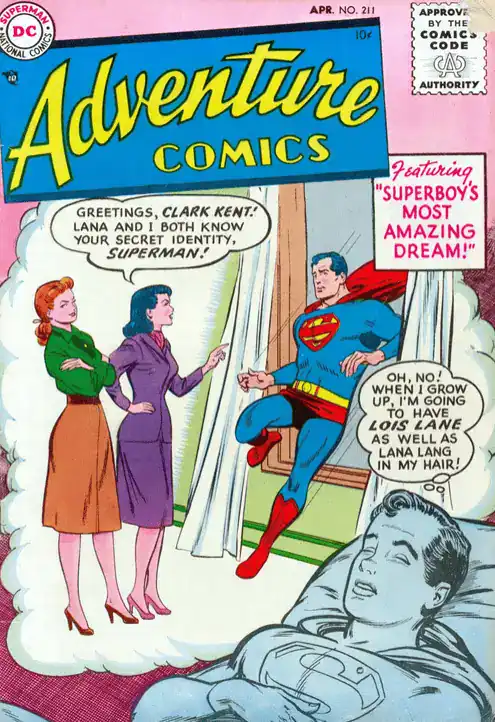
The reasoning for why this issue in particular is considered the first Silver Age appearance of Aquaman is that he wears green gloves instead of yellow gloves.
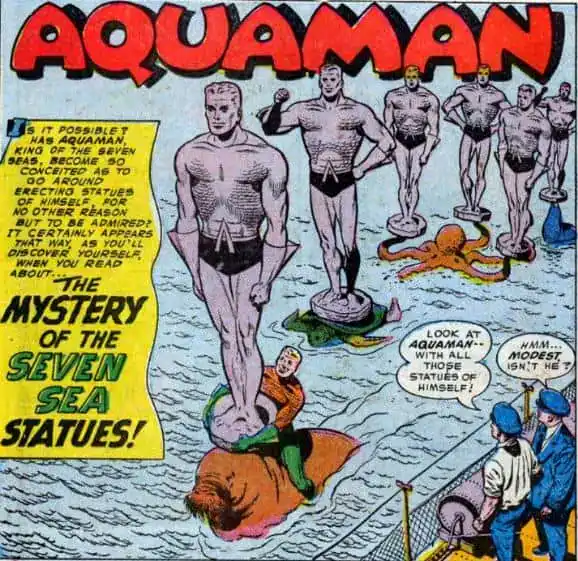
Because this was never intended to be a new chapter in Aquaman’s life, he’s treated as already being an established hero.
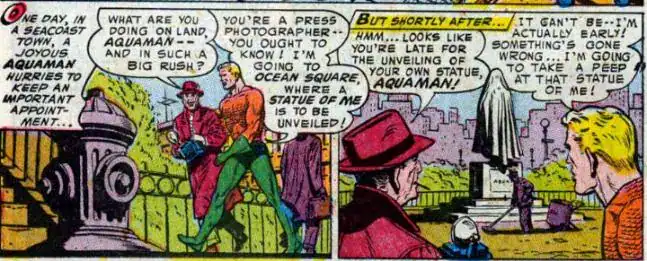
And he seems to think highly of himself, considering how offended he is that they didn’t complete a statue of him.
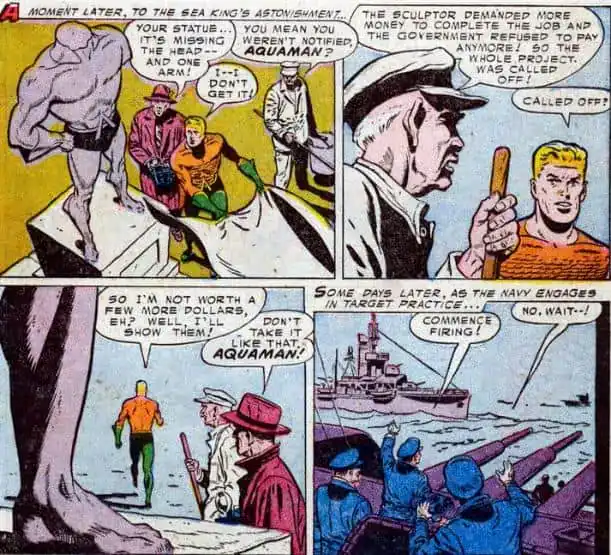
Completely normal behaviour, no notes.
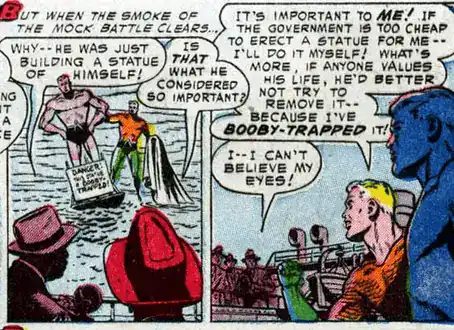
Despite gathering a less then stellar reputation over the years, Aquaman can indeed be awesome…
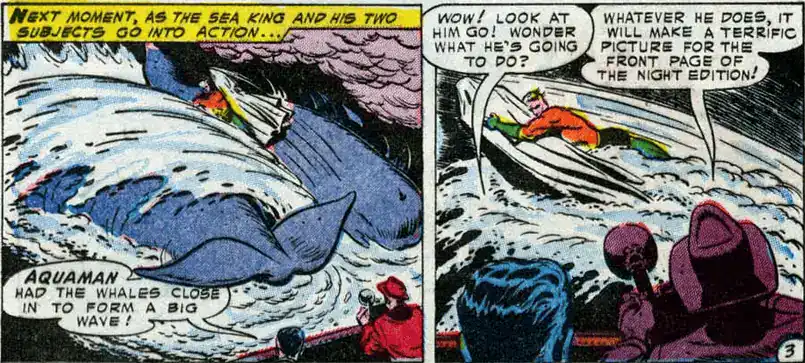
…when he’s not being a Moby Dick.
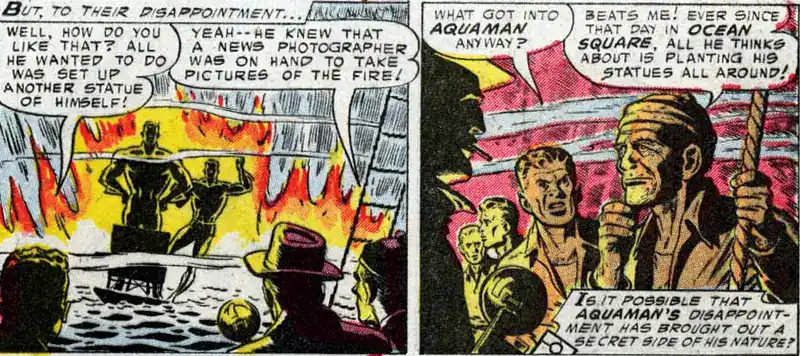
Wait until the Marine Board Of Inquiry hears about this!
Whatever it is that they do!
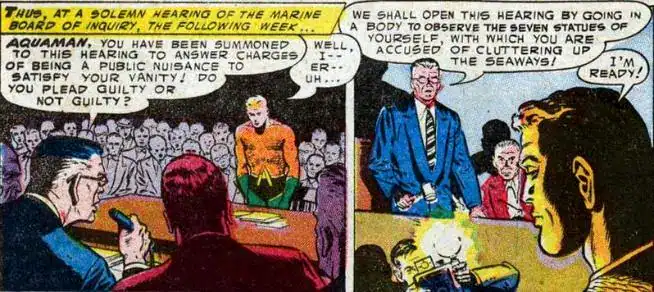
And he gets his statues blown up.
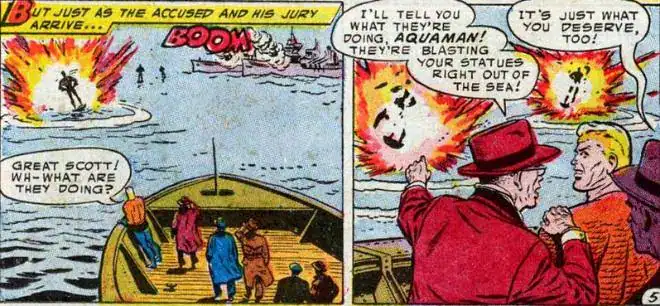
But that’s okay because the Navy was just using Aquaman as an excuse to test the Attractornator™.
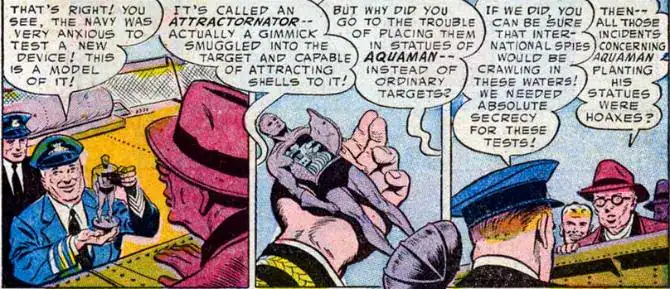
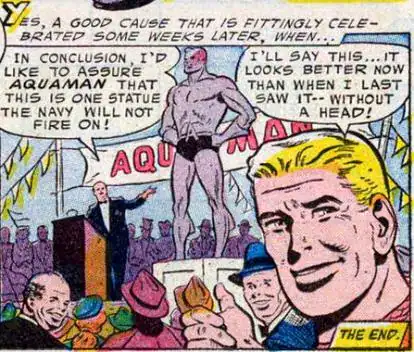
Well that was, uhm, that was six pages.
Historical significance: 0/10
There’s really nothing but the gloves to pinpoint this as the first Silver Age Aquaman story.
Something that is even less significant because occasionally in the Golden Age he did have green gloves AND because they will fluctuate between green and yellow for a few more issues.
Silver Age-ness: 6/10
That was the best way to test the device? Really?
Does it stand the test of time? 2/10
Ramona Fradon is one of the unsung great artists of the Silver Age. There are a couple of gorgeous panels here, but the utter lack of a compelling story has aged poorly.
How close is this to the modern character?  / 10
I have to admit that my knowledge of Aquaman is incredibly limited, so I’m not guessing how similar he is today to the Silver Age. And as a major DC character for decades, it would take WAY TOO LONG to go through his entire publishing career.
He would join the Justice League in its first story in 1960; adding to the confusion about his chronological placement, he has yellow gloves in that story.
The following year he’s given a three issues of Showcase, one of which includes his origin.
As discussed in Aquaman’s first story, this is when he officially becomes Atlantean; it would make sense to consider THIS Aquaman’s first Silver Age story, but it would be awkward considering he was already a member of the Justice League by that point.
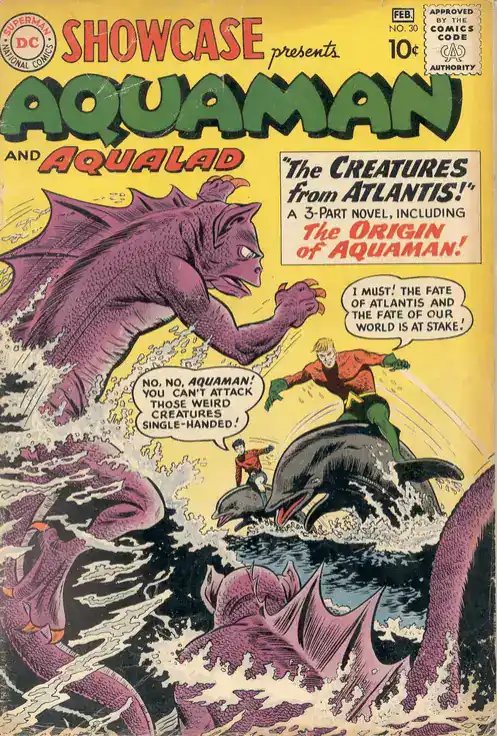
An Aquaman series was launched in 1962 and it lasted 63 issues until 1978, but that’s with a 6 year gap in-between. He did have other runs as a backup feature on Detective Comics and World’s Finest, of all places.

Aquaman struggled to keep a consistent series later. He was first a backup feature on Adventure Comics, which changed its title to Aquaman, but that lasted only seven issues after the change. He would bounce around World’s Finest, Adventure Comics and Action Comics for the rest of the pre-Crisis incarnation.
The curse would eventually be broken by the Peter David series, running from 1994 to 2001: with its 75 issues, as of 2025 it remains the longest Aquaman series to date.
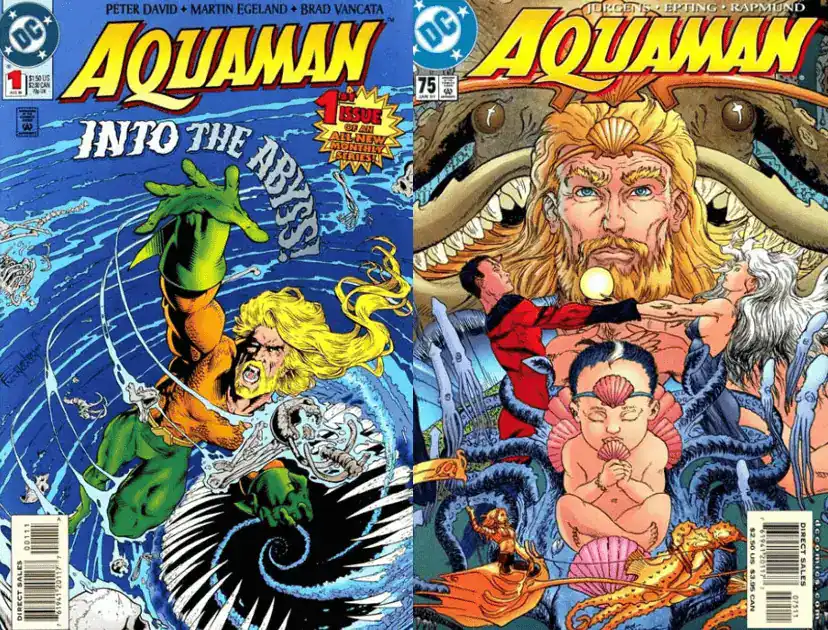
As a massive Peter David fan, his version is the only one that only drew my attention (it also helped that he got attention in Morrison’s relaunch of the JLA).
All Aquaman versions after the 70s struggle to get past the damage done to the character’s reputation by the Super-Friends cartoon; the 90s version might have tried the hardest, but it’s also the one that convinced me the most.
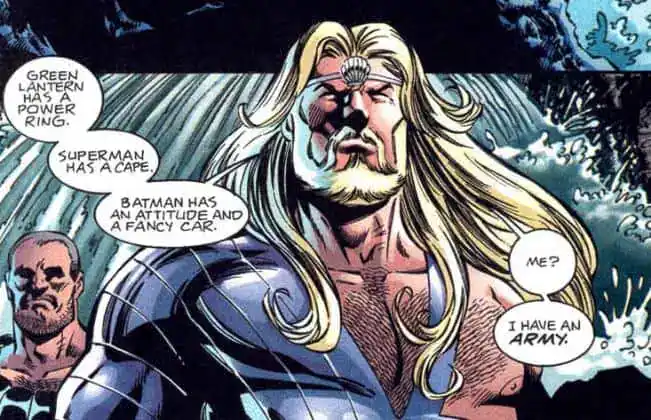
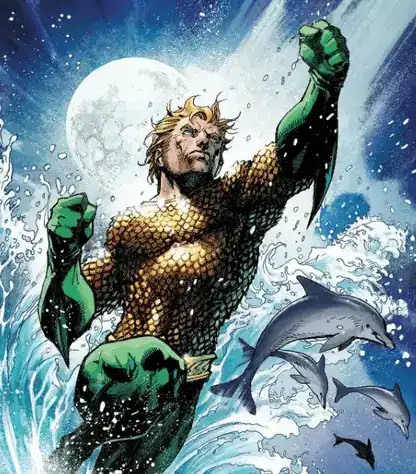
I haven’t paid much attention to Aquaman after he returned to his more traditional look and attitude. Nothing against the guy, he tends to be a good addition to the Justice League, but I don’t find the character particularly appealing.
Back to Adventure Comics #211, it has a Green Arrow story set underwater.
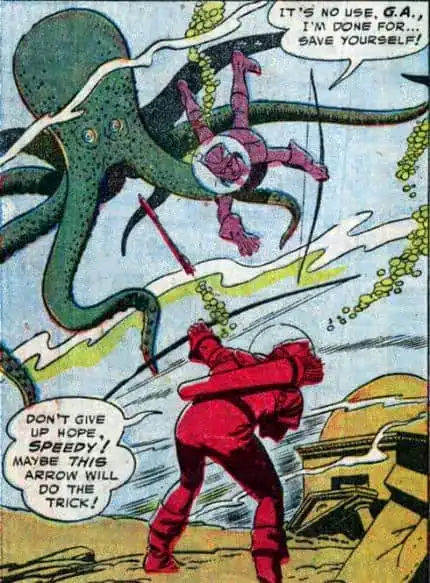
But that’s not considered the Silver Age Green Arrow. For that we have to wait for…
Adventure Comics #256 (1955)
by Ed Herron & Jack Kirby
cover by Curt Swan
…the same series, four years later.
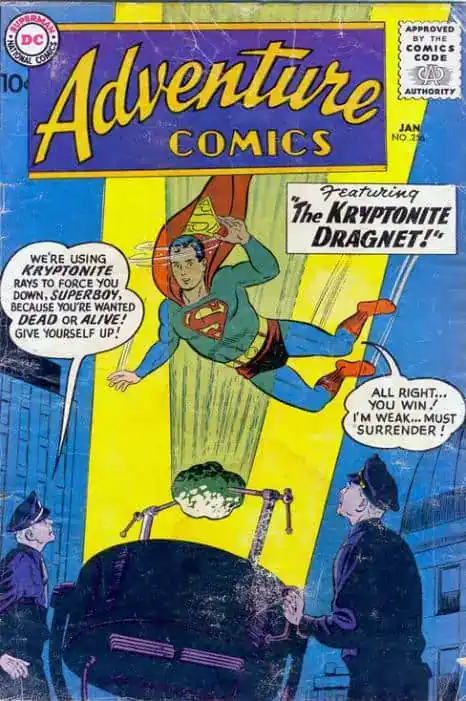
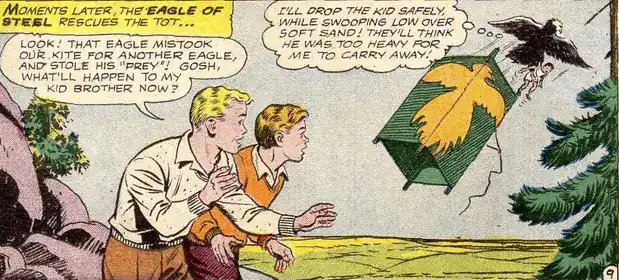
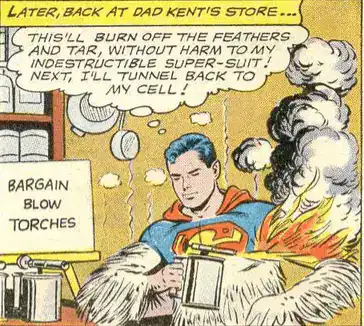
It has a Superboy story where he disguises himself as a bird.
So THAT’S where the catchphrase comes from!
It also has an Aquaman story where he orders his pet octopus to milk a cow so he can take a bath.
The things I have to type for these reviews…

I am cheating a bit with Green Arrow because, if I applied the same rules of Aquaman, then the first story set in the Silver Age would be Adventure Comics #250.
But I’ve already reviewed that one, and the only reason it’s considered the Silver Age version is because it’s clearly the same Green Arrow of THIS issue, which reveals his origin.
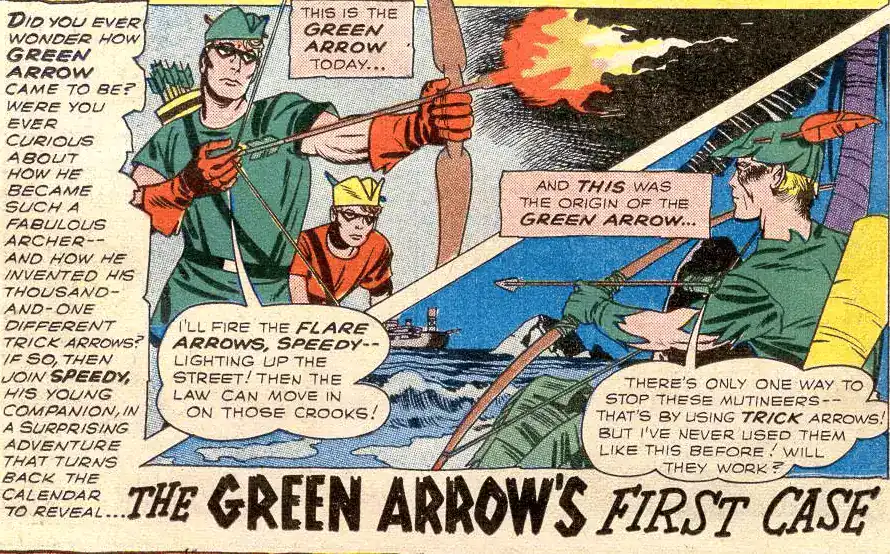
In his new origin, Oliver Queen is a rich playboy who gets stranded on a desert island.

Where he came up with ideas for trick arrows.
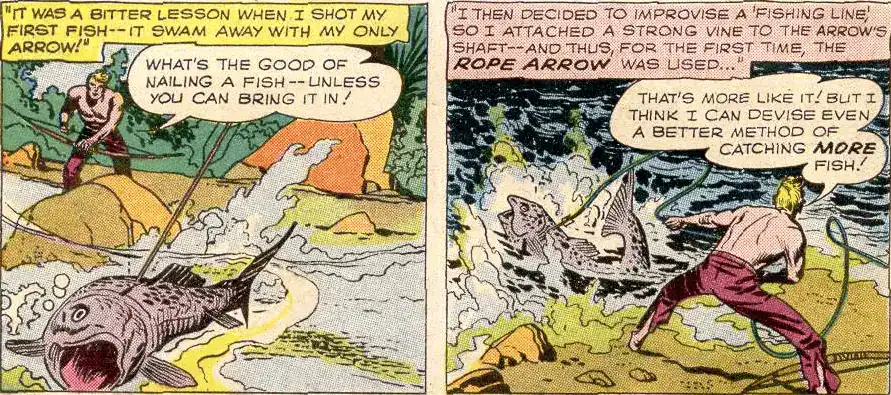


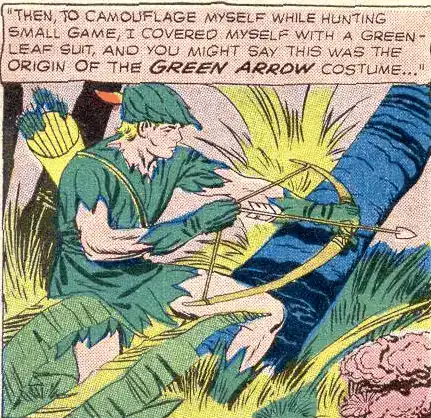
Getting bored on the island, he entertains himself with a Robin Hood cosplay.
He eventually rescues himself when a ship attacked by pirates drops by.

The framing device for telling the story is that someone has discovered the island, so Green Arrow pulls his trusty Fake Uranium Arrow to ensure nobody gets it.
All because he didn’t want anyone to read the diary he left behind.

I struggle to find an actual use for that arrow.
Historical significance: 8/10
The new origin sticks around. Mostly because his Golden Age origin, him being trained by Native Americans, is barely ever addressed (it will carry through with Speedy though).
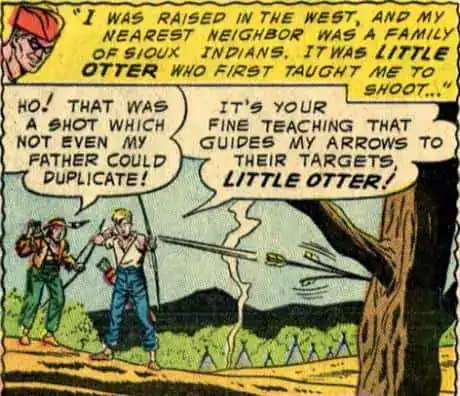
Silver Age-ness: 2/10
It was an easy 0/10 until the Fake Uranium Arrow.
Does it stand the test of time? 8/10
Surprisingly solid, mostly because of Kirby’s stunning attention to detail and storytelling, without dismissing the Ed Herron contribution (possibly the script). For such a brief story it does sell you Oliver’s will to survive and improve.
How close is this to the modern character? 4/10
I am slightly more familiar with Green Arrow, but he’s still stuck in the phase where he was basically just Batman with arrows.
It’s interesting to see that, while he shared the same series as Aquaman, he wouldn’t immediately join the Justice League until 1961.
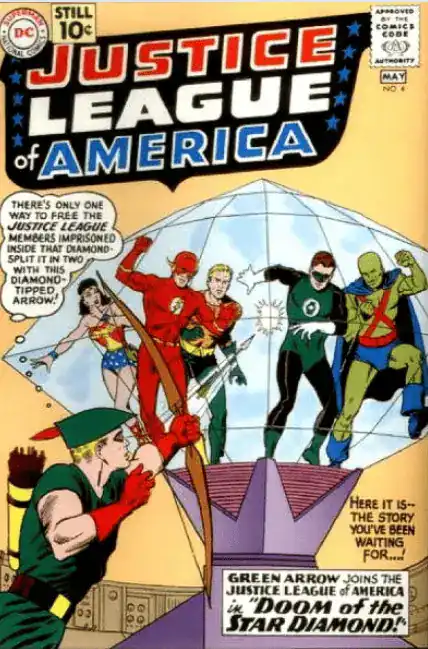
He would need more time to become the character we can recognize today: it’s not until 1969 that he gets his goatee, together with a new costume.
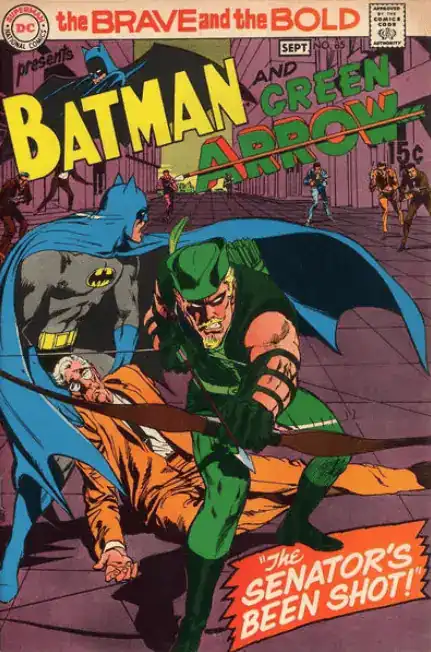
But 1969 would change Green Arrow in more ways than his looks, because in Justice League of America #75 Denny O’Neil makes significant changes: Oliver Queen loses his fortune, grows a social conscience, and begins a long-running romance with Black Canary.
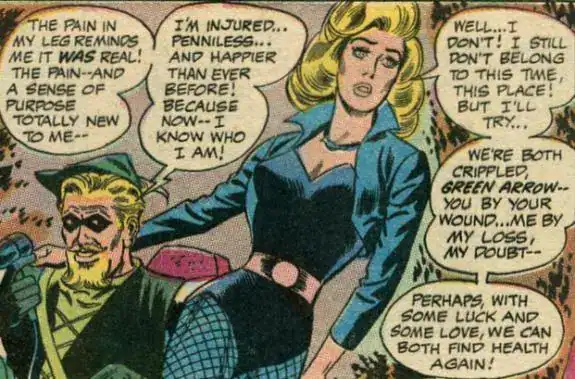
If Aquaman struggled to keep a series of his own, Green Arrow had worse luck even when he became an interesting character.
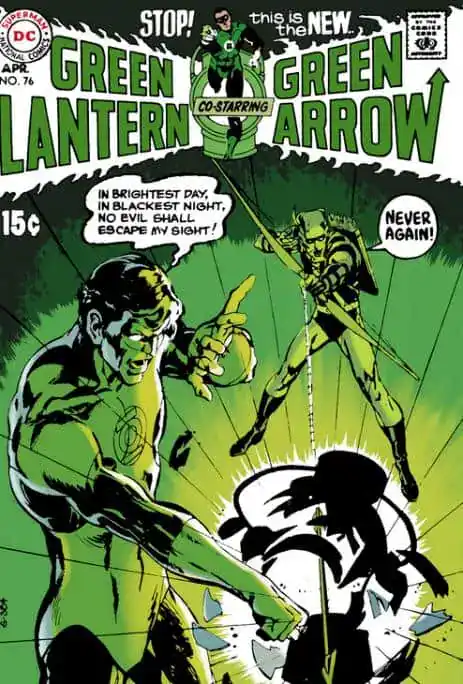
His claim to fame was the groundbreaking Green Lantern series, which became Green Lantern/Green Arrow for several years in the 70s.
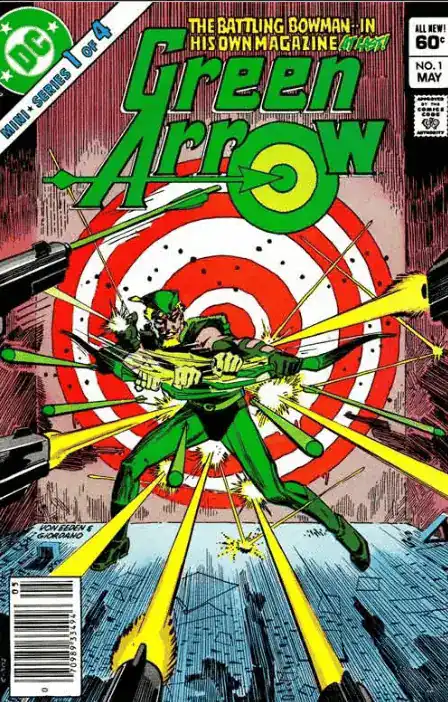
In fact, Green Arrow doesn’t get his own series until 1983, and that’s just a 4-issue miniseries.
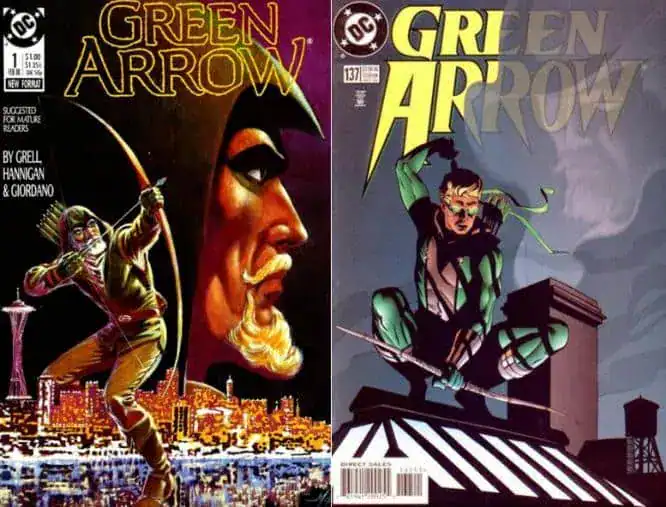
The first full series wouldn’t come until 1988, lasting 137 issues until 1998: as of 2025, that’s still the longest running Green Arrow series.
Although Oliver Queen only starred in the first 101 issues, dying and being replaced by his son Connor; but even if you only counted those 101 issues, it would STILL be his longest run to date.
Aside from his 70s version I haven’t followed Green Arrow a lot, and I think his romance with Black Canary is overrated.
But I like having him in the Justice League: they really need someone with a more down-to-earth perspective to keep them humble, and Green Arrow does it better than anyone at DC.
Even if he’s anything but humble himself.

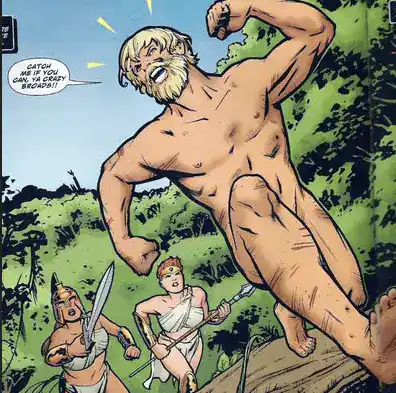
Just keep an eye on him because this guy cannot keep his arrow in his pants.
The only thing I can say after reading this review is that if I were on the market for a blowtorch, I would probably spring for a good model rather than being lured into buying a bargain one. Sounds way too unsafe.
Green Arrow had surprising success in the small screen, as Arrow wasn’t just 8 well-written seasons, but also the centerpiece for what became known as the Arrowverse. In the Arrowverse version of Crisis on Infinite Earths, Oliver takes on the mantle of the Spectre and gets to wrestle the Anti-Monitor into submission.
Currently, Green Arrow’s monthly is about to be cancelled again, but DC is axing a lot of titles in preparation for a wave of new books in 2026.
Aquaman is currently written by Jeremy Adams, a master of misogyny. Mera’s aquakinesis has been handed over to Arthur, as if Aquaman didn’t have enough powers of his own. Thanks to time shenanigans, Aquaman and Mera’s daughter is both a teenager and an infant at the same time.
Aquaman gaining Mera’s powers annoys me to no end. I always thought she was the cooler character with a unique power-set and DC took it away to buff up Arthur’s cred.
If Adams wanted to write about someone with aquakinesis, he could have written Mera… but of course he couldn’t, because Mera is female. He also gave the warrior queen a death scene where she drops dead in bed, of old age. Over in Green Lantern, he writes Carol Ferris as a newbie who craves Hal’s approval, when she was a girl boss back in the sixties.