
We lost another giant of comics. Quite literally.
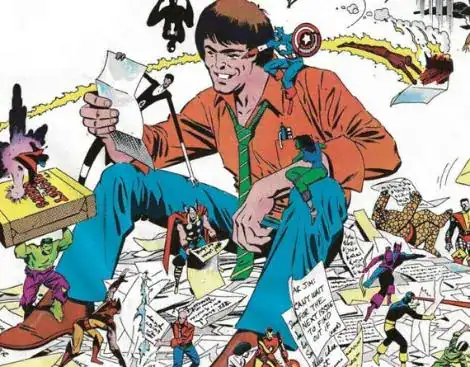
SHOOTER’S FIRST DC COMICS YEARS
Shooter’s career is one of the most unusual in the business, starting when he was in a hospital for minor surgery in 1963.
(most of the quotes below come from an interview for www.nycgraphicnovelists.com)
I was 12. I hadn’t read comics in years, I think since I was eight years old. There were a lot of comics in the kids’ ward. There were DC comics, and I read them. They were the same as when I’d stopped reading them. Then there were these other comics, all kind of ratty and dog-eared because they’d been read so much, these new-fangled Marvel Comics. I read them and went ‘Holy cow, these are good!’ At that moment, I got the idea that if I learned to write like this Stan Lee guy, I could write for these other turkeys, DC, because they sure needed the help.
JIM SHOOTER
Even at this young age, you can tell just how methodical he was.
I spent about a year reading, studying comics, trying to figure out what I liked and what I didn’t like – I read both DC and Marvel – and tried to figure out what Stan was doing. When I thought I was ready, in the summer of 1965 and I was thirteen years old, I wrote and drew a comic book story for The Legion of Superheroes. I thought that was the one comic I could make the biggest difference with. I made a cover for it, which I also colored, and everything. I didn’t know what a script looked like, so I made it look like a comic book and drew the panels and wrote the word balloons. I sent it in to DC Comics, and got a letter back that said ‘Hey, we think you may be able to draw features for DC Comics!’
JIM SHOOTER
He was doing everything he could to get the book to be as Marvel as possible.
I also realized that I was doing this to sell. I mean I think what most kids do is in their first issue they kill Aunt May and whoever their favorites are get married and they just do sweeping changes and stuff, and I realized that if I wanted to sell this, it’s got to fit in the pattern; so I was very canny about it. I tried to do a little bit of what Stan did. For instance, one thing I noticed was that Stan’s people talked better; they talked more humanly and that they had more personality. So I tried to do that. The thing is I really wasn’t a good enough writer at age 13, but since I didn’t know what a comic book script looked like, I actually drew every panel. Kind of a crude drawing.
JIM SHOOTER
As every Legion fan knows, that’s the origin story of Adventure Comics 346.
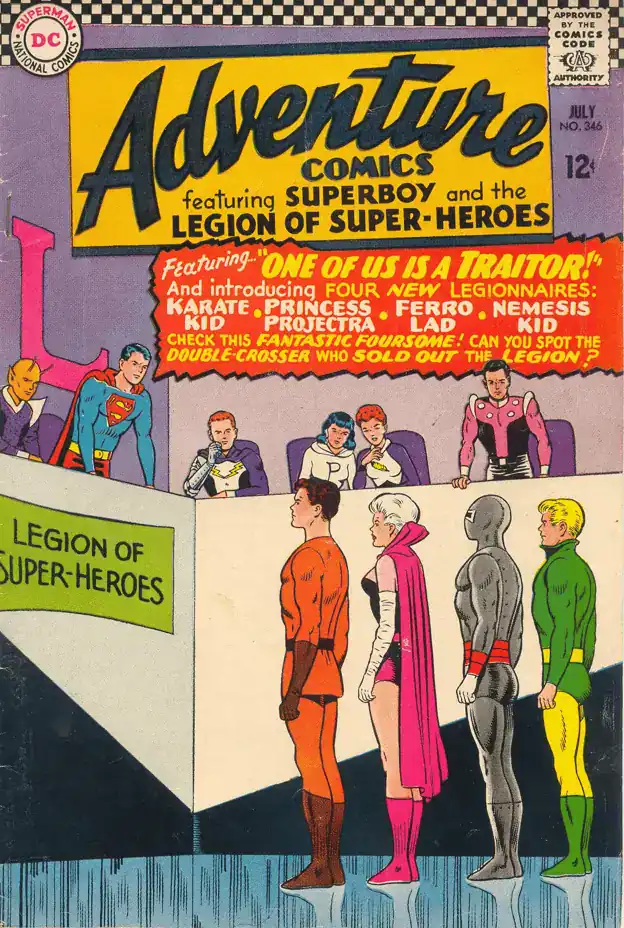
Shooter’s life, and consequently the history of comics, changed when he received a phone call on February 10th 1966.
Sometime in the evening I got a phone call from a guy who said his name was Mort Weisinger and he wanted to buy the stories I’d sent. He commissioned me to write a Supergirl story. People have occasionally said ‘Mort really plotted everything.’ No, my instructions on Supergirl were ‘Supergirl, twelve pages’. Most of them were like that, and I’m not saying we never had story conferences. I sent in the Supergirl, and he liked it and said ‘Send me a Superman, twenty-two pages.’ I sent him ‘The Origin of The Parasite’ and then I was back on Legion again.
JIM SHOOTER
Parasite in particular came from the realization that Superman’s rogues gallery was lackluster.
They asked me to write a Superman story and I looked at the Superman villains lying around and thought, really, this guy hasn’t had a new villain forever. And the villains he had were all scientists or sneaky guys. They weren’t real heavyweights.
So, I wanted to have somebody who was a physical challenge for him. So, I was in 9th grade, and in Biology class we’re studying parasites and I said, “Hey!”
JIM SHOOTER
That would be the beginning of a very rocky relationship with Weisinger.
When he told me he wanted me to do Legion regularly, that was the phone call – I lived in Pittsburgh, Pennsylvania and all of this was over the phone – and he said ‘I want you to come up to New York and spend a couple of days in the office.’
I said ‘Okay,’ but I was hesitating.
He said ‘How old are you?’
I said ‘Well, sir, I just turned fourteen.’
‘Put your mother on the phone.’ I believe he thought I was a college student. So the business trip had to wait until school let out, and I had to take my mother with me. It’s really embarrassing to have to take your mother on a business trip.”
JIM SHOOTER
Even interviewed about it decades later, I can believe Shooter is still impressed by how thought he put into the Legion.
You know one of my problems with the Legion was that there were too many guys with powers where they’d point their fingers, I mean that’s it, whereas with Marvel comics people actually hit things, knocked things over and lifted things. So, I tried to come up with guys who were strong and powerful and knew karate and stuff like that. But other than that, with a lot of those early characters I just one day said, “Ferro Lad.” Hey, I lived in Pittsburgh. It’s a steel town.
JIM SHOOTER
Shooter’s success story is the dream of everyone trying to break into comics, but he had very pragmatic reasons to keep going.
My family needed the money. I was doing this to save the house; my father had a beat-up old car and the engine died – this is before I started working for DC – and that first check bought a rebuilt engine for his car so he didn’t have to walk to work anymore. I was doing this because I had to, working my way through high school to help keep my family alive.
JIM SHOOTER
You can definitely see a reflection of this struggle on the pages of Action Comics 381; if we go by that subtext, it looks like Shooter resented missing out on his teenage years to be the family’s provider.
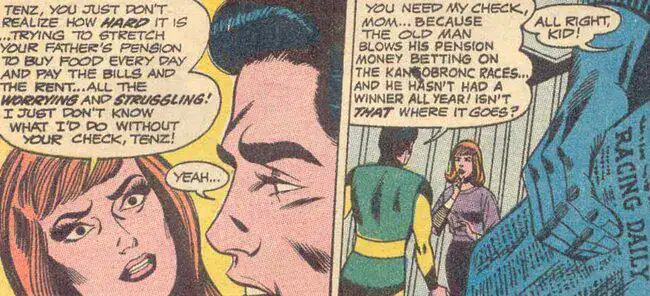
Weisinger’s influence over Shooter can’t be overstated. Shooter made countless comments over the decades about how Weisinger’s example set the tone of his own stint as an editor (more on that later), and it looks like later in life he might have considered Weisinger to be something of a father figure.
Not a particularly positive one, though.
So, when he was going over the material I had sent in earlier that week, he’d go over it panel by panel, word by word, page by page, he would start spewing ‘You idiot!’ He was just screaming at me about what a ‘retard, fucking moron I was, and how stupid I was every time he saw a spelling error or any kind of mistake. I was still doing rough sketches for every panel – I always did – and he also criticized my drawing: ‘What’s this guy holding? Is that supposed to be a gun? It looks like a carrot! You fucking moron!’ That’s a quote: that really happened.
He really got nasty, and he’d scream at me for misspelling a word. It got to the point where every phone call would end with me saying ‘Look, maybe I’m not good enough to do this, and maybe you should get somebody else.’
His line then was ‘No, I’ll give you one more chance. I know your family would starve without you. You’re my charity case.’ It got to the point where, if I was anywhere and heard a phone ring, I’d get white-knuckled. I would be at school, and if a phone rang within earshot, I would freeze up. It was horrible, and it wasn’t just with me, he’d do that with everybody.
JIM SHOOTER
At the same time, Weisinger seems to have been a real mentor for him.
When I would go up on business trips, Mort would sit me down and teach me storytelling: establishing shots, setting the stage, introducing the characters, establishing characters – all of this stuff. Mort would also lecture me about the business, explain to me about licensing and international publishing. He had done a lot of that. He was responsible for getting Superman on Broadway, and also for a lot of other media and merchandise licensing – TV, radio, toys and more. He told me about the business and how it worked, including the economics of it, and gave me Publishing 101, in between his telling me what an idiot I was. Nelson believed he was grooming me to be his successor.
I have no idea if that was true or not, but I know he taught me a lot about the business. He was extremely knowledgeable, and not just about comics, but also about the business, as well as the production. I learned an awful lot from him.
JIM SHOOTER
I truly believe that the original Shooter run is what truly put the Legion on the map.
Hamilton might have been the one to evolve them from Superboy supporting characters to their own universe, but Shooter was the one to make the characters feel truly alive.
Although Hamilton was a true gentleman.
So years later Nelson Bridwell told me that Edmond Hamilton somehow found out what I was getting paid, which was way substandard and went into Mort and threw a fit. He said, “It’s bad enough you’re using child labor, but do you have to rip him off, too?” (Laughter.) And shamed him into giving me a raise, and then after that I got a couple more raises. I think I ended up with $14.00 a page, which was kind of normal in those days. I don’t think that story is apocryphal. Nelson told me that and I believe him; that Hamilton went in and championed my cause, (chuckle) and I was the guy that was taking his job.
JIM SHOOTER
By the time Shooter was 17 years old, however, the constant abuse had taken its toll.
He also had a New York University scholarship waiting for him, so he decided to change things.
Here’s a succession of miracles: I call Stan. The receptionist puts me through! Nobody got through to Stan back then. I must’ve sounded important or desperate. ‘Hi, this is Stan!’ It’s Stan Lee on the phone.
“I said ‘Stan, I’m a writer, and I’m currently writing for DC Comics. I want a change.’
“He said ‘We don’t like the writing for DC Comics.’
“I said ‘I don’t either. I got the job at DC because I learned from your stuff. They call me their ‘Marvel writer’ and mean it as an insult.’
“He says ‘I’ll give you fifteen minutes.’
“I went up to his office, and three hours later I had a job. We were discussing our theories of comics, and they were the same. Of course. I learned it from him.”
JIM SHOOTER
It’s really, really hard for me to read Shooter’s recollections of Weisinger and not hate the man.
The first day I worked at Marvel, word got to Mort and he called me to scream at me one last time. ‘You ingrate, fucking retard.’ He called me at my desk at Marvel Comics to scream at me about what an ungrateful bastard I was. At that point, I was just like ‘Okay.’
I met Cary Bates for the first time, years after we’d worked for Mort. The first words out of his mouth were ‘I used to hate you…Every Wednesday night, Mort would call me up and say ‘Why can’t you write like Shooter? His stuff is good, and yours reads like the Manhattan directory, you fucking retard.’
I said ‘Cary, he said that to me. He’d say ‘Bates always has great cover ideas, he always has clever trick endings. Why are you so dumb, you fucking retard?’
At that same time, Nelson Bridwell, who had been Mort’s assistant the years I’d worked for him, told me ‘Mort bragged about you. He would take your work around and show it to the other editors and say ‘Look at my discovery.’ He would brag about how he never had a rewrite or to change a thing, because he could give you any story or any character and you would turn in something that was ready to go, and ready to print. He was so proud of you.’
“I said ‘He might’ve let me know, it’d have been nice.’ But that’s how things were back then: if you were an editor, your job was to crush writers under your heel and keep them from asking for a raise.
JIM SHOOTER
Jim Shooter’s tenure at Marvel lasted a whole three weeks: his first credited Marvel work is Super-Villain Team-Up #9.
Between working in comics and going to university… Shooter chose neither, returning to Pittsburg to work.
I did a whole bunch of unglamorous things. I polished cars, worked in a department store, worked in a lumber yard, chemical plant, I washed dishes and was also a security guard. However, very soon after I moved back to Pittsburgh, I got a call from an advertising agency:
“‘Are you the kid who does comics?’
JIM SHOOTER
SHOOTER’S RETURN
And that’s where the story would have ended if it wasn’t for the birth of the Legion fandom.
A couple of years after that, a guy called me up to interview me. His name was Harry Broertjes. He was a journalism student who published a fanzine called The Legion Outpost. He did an interview with me and, after the interview, he asked ‘Why don’t you work in comics any more?’
“I said ‘If they want me, they know where I am.’
“He called his friend Duffy Vohland, who was an assistant editor in the British department at Marvel, and said ‘I was just talking to Jim Shooter. Here’s his number.’
JIM SHOOTER
Jim Shooter was given work at Marvel by none other than Roy Thomas, who assigned him to write Man-Wolf.
There are curious parallels between Shooter and Thomas, since the latter also started out as a fan (through the fan magazine Alter Ego) and had even been Weisinger’s assistant for a whole 2 weeks before jumping to Marvel.
The two would have a VERY rocky relationship. Mostly because their editorial styles were WILDLY different, but I’m guessing Thomas resented how Shooter quickly left.
I went over to DC, and Nelson Bridwell came out to meet me in the reception area, took me to see Carmine Infantino, who was the Publisher. Carmine walked me in to see Murray Boltinoff and said ‘This is Jim Shooter, give him some work.’
Murray was sitting there with Cary Bates, and it was the first time I met Cary. Cary said ‘Give him the Legion, I hate it.’ So, they did, and he walked me in to see Julie Schwartz and said ‘This is Jim Shooter, let him write Superman.’
Julie said ‘Anyone who was good enough to work for Mort is good enough for me.’
So, I had Superman and Legion at DC and Man-Wolf at Marvel. At least I knew who the characters were at DC, so I decided to pass on Man-Wolf. I would have had to do a lot of research just to get up to speed with Man-Wolf.
JIM SHOOTER
That return lead to a second Shooter run on the Legion, among other work at DC Comics… but he didn’t have a good relationship with their editors, leading to another jump.
Then when Marv Wolfman called me at the end of 1975 and said he was looking for an Editor at Marvel, I said ‘I’m your man.’ I flew up and, once again, arrived on a Monday with my suitcase, but I had money now. I wasn’t missing any meals.”
JIM SHOOTER
JIM SHOOTER AND MARVEL
At this point, Marvel Comics was quite different from what Shooter recalled… and from what was going on at DC.
The atmosphere when I first went up there was very laid-back and nobody wore a coat and tie. This was a contrast, because at DC, until 1977, they would not allow you to enter unless you had a jacket and a tie! You weren’t allowed in. In 1977, Cary Bates and Marty Pasko, on a bet or dare, went to the office with sports coats and open collar shirts, and they got in. It was the talk of the industry. The DC dress code started to break down after that.
Marvel was casual and laid-back. There was somebody sleeping under a desk. There was a giant papier mache figure of Thor made by fans that was hanging from the ceiling. People came to work dressed to paint a house. Nobody cared. It was home: very casual, and very laid-back. Sleeping under a desk? Why didn’t I think about that the first time?
JIM SHOOTER
And that might have saved Marvel because while their laid-back attitude was great for morale, it was a disaster for everything else.
Besides the Editor-in-Chief, the other people that they had in the office were so-called ‘proofreaders’; there were four or five of them. The way that it would work is this: A writer would be assigned to a book, like Steve Englehart on The Avengers. Steve Englehart would write a plot, send it directly to the artist. The artist would pencil the story (it was all done Marvel Style, of course, art first, dialogue added later), and send the penciled pages back to Steve. Steve would write the dialogue, indicate the balloon placement and send his copy and the art to the letterer. The letterer would letter the pages, and send them to the inker, who would ink the book. So, the first time the issue was seen, the first time anybody in the office had any clue what it was about, was when it arrived finished, all but colored.
So then the proofreaders look at this stuff and say ‘Oh my God, you can’t do this! This guy’s dead! The costumes are wrong! There are disastrous continuity problems! This won’t pass the Code! Etc.’ They’d lose their marbles, then rush down to the Production department, having panels redrawn, having dialogue rewritten (and of course the writer is screaming ‘How dare you touch my dialogue!’).
JIM SHOOTER
After a tumultuous period when Marvel went through several Editor-In-Chiefs in the span of a few months, Shooter was eventually promoted to the position by the President of the company that now owned Marvel.
And despite Shooter’s maligned fame of being hostile to creators, his first order of business was making sure they’d get paid.
“I said ‘I want to pay royalties.’
“He said ‘You mean we don’t!?’ He’d come out of real world publishing, and hadn’t paid attention to the details of comics publishing. He honestly didn’t know we didn’t pay royalties.
‘No. I want to set up a system that rewards creators. If you write something that sells a million copies, you’d get more of a paycheck than the guy who writes Ghost Rider this month would get.’
[CUT FOR BREVITY]
I could do anything that was self-liquidating. I started right away to build this royalty system. I sat down with the financial officer, trying to work out a fair system. He kept complicating it. For one thing, he said ‘It should only be for an increase in sales, and shouldn’t be that whoever’s on Spider-Man now gets more than who’s on Ghost Rider.’
“I said, ‘No, that’s okay. What’s going to happen is that the better guys will do Spider-Man, and we’re going to get a star-driven business.’
JIM SHOOTER
And that was the beginning of one of nastiest feuds in Shooter’s career.
We argued about that, and then two things happened: Kirby threatened to sue us. The word ‘royalty’ implies ownership, and it put us in an awkward position that could be used against us in court. The same with the artwork returns: the way his lawyers phrased his demands, that ‘Kirby wanted his artwork’ back. To give it back, would have been tacit admission that he owned it and had all the rights. Kirby single-handedly held up the return of artwork and the royalty system for a while. Gerber helped when he sued us over Howard the Duck.
So, lacking a royalty system, I needed an incentive for these guys, and I set up the ‘continuity bonus’: You do three issues in a row, and you get $500 bonus; you do six issues, and you get $1,000. You get $500 every three issues you put out. I did it to keep the same guy on the books. That worked. It was the first incentive system in mainstream comics.
Also, I introduced life insurance: If you earned $7,500 a year at Marvel, freelance, you got a $10,000 life insurance policy automatically. Health insurance: if you earned $7,500 a year at Marvel, freelance, you were covered by our major medical. Most guys could do that in a couple of months and were covered.
JIM SHOOTER
Reading this interview, it’s easy to see why Shooter became controversial among creators… and just how much Shooter was trying to create a better industry.
If only he had any clue on how to deal with people without coming off so aggressive.
I also found out that the squeakier wheels who had creator contracts had the best benefits. Joe Sinnott had worse benefits than Mike Esposito. I said ‘No, no, no. Standardize. Make the contracts exactly the same for everyone.’ The same, in fact, as staff people.
I fixed a lot of things, but my greatest frustrations were the royalties and artwork return, which were delayed by lawsuits.
I also increased rates, doubling them, and then doubling them again, because we started to make more money. I also straightened out some gross negligence; Don Perlin, who had been there forever, had the lowest pencil rate. I gave him a raise, and quickly another raise. He thought I wanted to date him, or something like that. He was like ‘Wow! Why are you doing this?’ Because it’s right.
I tried to standardize and boost the rates up. Superstars like Frank Miller? He got paid like the old guys, because he’s Frank Miller. I did respect the creative contributions like the age and seniority of the guys. I made sure guys who’d been there for twenty years weren’t getting the minimum. I also respected genius.
JIM SHOOTER
SHOOTER’S ACCOMPLISHMENTS AT MARVEL
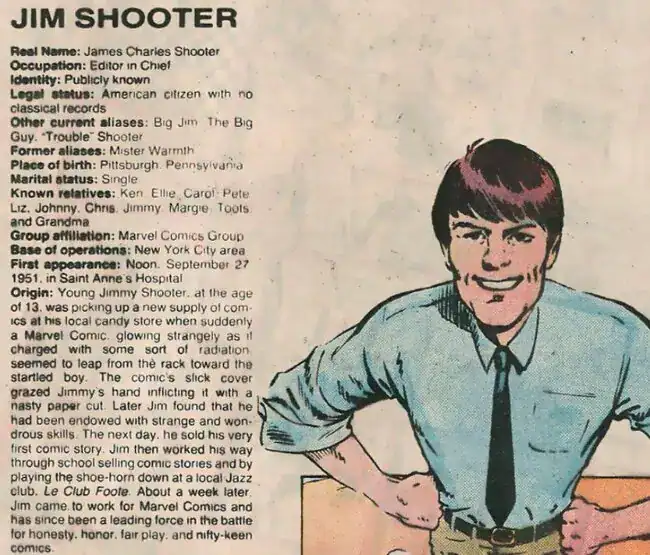
Shooter’s tenure as Editor-In-Chief oversaw some of the most celebrated runs: Claremont on X-Men, Byrne at Fantastic Four, Frank Miller on Daredevil, Walt Simonson on Thor, Roger Stern on Avengers and Amazing Spider-Man, the first Peter David stories, and the first Marvel/DC crossover.
But there are other milestones: Dazzler was the first series sold through the direct market, started the Epic line for creator-owned series, and basically invented company-wide crossovers with Secret Wars.
He also ended up launching the G.I. Joe series in an… unusual way.
The President or CEO of Hasbro was at a charity event that Marvel’s President was also at. They ended up in the men’s room, standing to each other peeing, and I think that’s how they met. They were talking about each other’s respective businesses, and it came up that Hasbro wanted to reactivate the trademark on G.I. Joe, but they were trying to come up with a new approach. Marvel’s guy was like ‘We have the best creative people in the world! Let me bring in this Editor-in-Chief of mine and we’ll fix it for you!’
[CUT FOR BREVITY]
I had a meeting downtown, and I was there representing Marvel, they had a couple of advertising people there, as well as some Hasbro people. They had this G.I. Joe logo, and I think the slogan ‘A Real American Hero.’ They didn’t know what to do: ‘We were going to do the big dolls, but we’re inclined to make the action figures, but we don’t just want to have one of them, we want-‘
“I said ‘No, G.I. Joe is a codename of the unit, all in G.I. Joe.’
JIM SHOOTER
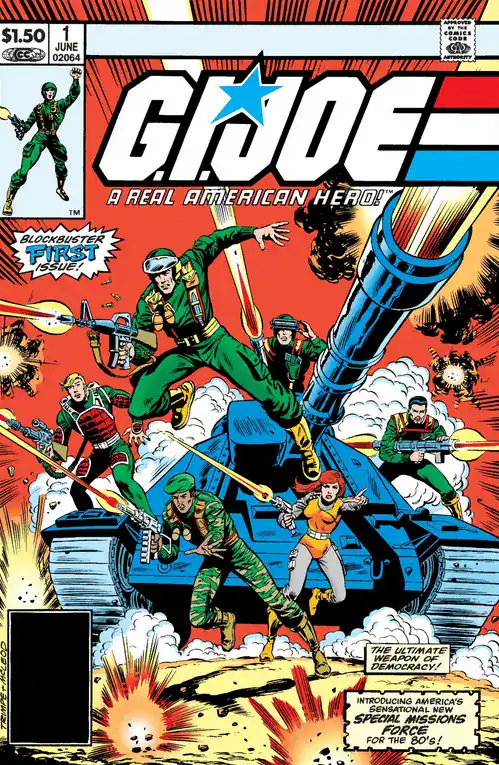
The comic book was successful (the top-selling subscription in 1985), and it was possibly the first comic book to be advertised on television thanks to the cartoon.
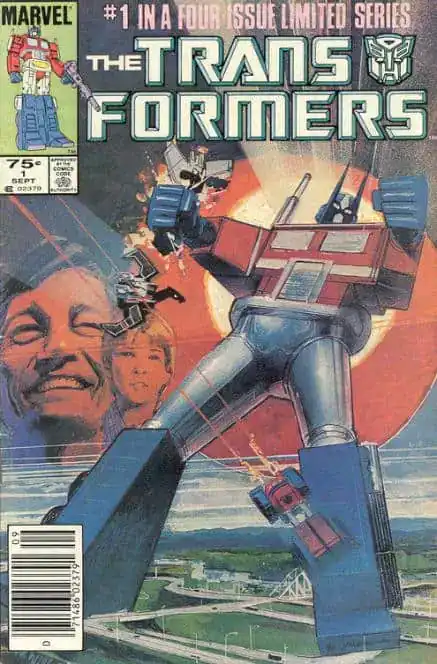
Because of the success of G.I. Joe, when Hasbro wanted to launch their Transformers toyline and the cartoon to promote them, they approached Marvel for the basics. The comic book ended up being published first.
Shooter and O’Neil came up with the backstory, that’s true. Shooter brought me in when most of the initial names and at least some of the character profiles were rejected by Hasbro. For whatever reason, Denny declined to revise them. So, facing an imminent deadline, Shooter scoured the Marvel editorial offices looking for someone who could write at least basic English. The first few Marvel editors Shooter approached, all with more writing experience than me, wanted nothing to do with Transformers. I was probably Shooter’s third or fourth choice. I turned around the revisions over a couple of days — right before Thanksgiving of 1983 — and Hasbro was very pleased with what I wrote. I renamed most of the characters (Optimus Prime was Denny’s, Megatron was mine), and revised some character profiles.
BOB BUDIANSKY
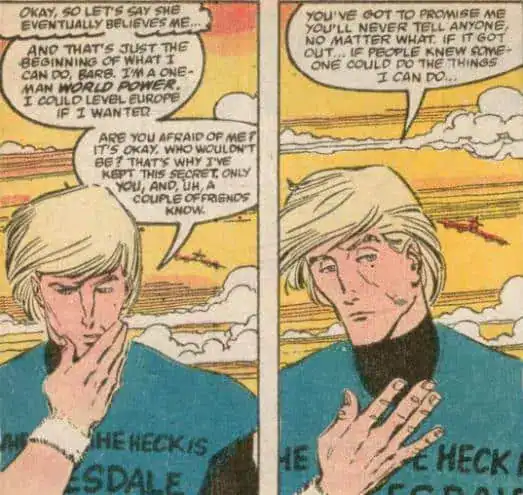
His celebration of Marvel’s 25 anniversary, through the launch of the New Universe line, was not exactly successful.
I found Starbrand in particular to be fascinating, to the point that I might do a serious retrospective on the series at some point. I believe it’s one of the best series to ever explore the idea of “what if a painfully average shmuck got the powers of a god and was the worst person for the job?”, though I don’t know if that was Shooter’s intention.
Those were the positives. But you can’t discuss Shooter’s tenure as EIC without talking about the fact that working under him was awful.
Shooter had feuds with nearly everyone: Steve Gerber, Marv Wolfman, Gene Colan, John Byrne and Doug Moench left for DC, mostly because DC’s Jenette Kahn was aware of the situation and was relentlessly taking advantage of the situation.
I’m certain Shooter approved.
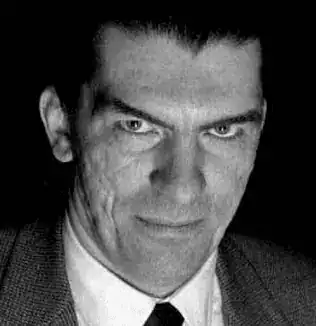
When Jim Shooter took over, for better or worse he decided to rein things in – he wanted stories told the way he wanted them told. It’s not a matter of whether Jim Shooter was right or wrong; it’s a matter of a different approach. He was editor-in-chief and had a right to impose what he wanted to. I thought it was kind of dumb, but I don’t think Jim was dumb. I think the approach was wrong, and I don’t think it really helped anything.
ROY THOMAS
Shooter had been great for the first two or three years. He got the creative people treated with more respect, got us sent to conventions first-class with our ways paid, and we thought the world of him. Then his Secret Wars was a big hit, and after that he decided he knew everything and he started changing everybody’s stuff
JOHN ROMITA SENIOR
Shooter came along just when Marvel needed him – but he stayed too long. Having fixed just about everything that was wrong, he could not stop “fixing”.
JOHN BYRNE
Ironically, I truly believe Byrne himself is guilty of overstaying most of his runs.
As forward-thinking as he was on comics, he had his flaws. His views on women and sex were either bizarre or old-fashioned, as we have seen on Dazzler and his weird Legion comments, and he was reportedly quite homophobic (writing a Hulk story that hasn’t aged well in that regard, and vetoing Byrne from revealing Northstar was gay).
Which is unfortunate because on other stuff he was really ahead of his time. For example, Ferro Lad was supposed to be black.
I thought why wouldn’t there be a black guy? But I suspected that would be a problem. So, I put the guy in a mask. Actually, the truth is, I drew him wearing a mask first, and I hadn’t really thought it all out, but being that he was conveniently in a mask, I thought, “Okay, he’s black.” He was in a mask in my first issue.
Then I mentioned the idea that he was black to Mort and he vetoed it. “No way.” “Why not?” He said “Because then all the distributors in the south won’t carry the book.” I thought, “Well, I don’t know how to argue with that.” Anyway, he adamantly refused. Meanwhile Marvel sort of bravely marched on and started having more and more black characters and stuff and they seemed to get away with it. By that time Ferro Lad was dead, so it didn’t make any difference.
JIM SHOOTER
I should also point out that some of those feuds should probably be blamed on the rest of the staff.
Jim was very good at being the boss. He certainly knew his stuff and he knew how to move projects from “A” to “Z.” Moreover, he didn’t care whether people liked him so much as he cared whether they liked Marvel. Coming from the Mort Weisinger school of Screw ‘Em If They Can’t Stand The Heat, Shooter was a kinder, gentler, smarter, more touchy-feely version of his mentor, the legendary DC Editor who kicked ass and took names and built a solid reputation for making the trains run on time. Jim made deals and threw money at people who couldn’t stand him. He routinely bought big-ticket Christmas presents for staffers he knew were plotting behind his back. He didn’t care about being the heavy: somebody had to be the heavy. But, for Marvel to survive and grow, the kids would have to grow up. And Shooter became the avatar of our painful adolescence.
CHRISTOPHER PRIEST
Interviewed decades later, Shooter was fully aware of his reputation… and still considered to have had the last laugh.
Well, when I was at Marvel, the legend is that I drove away all these creative people and that’s baloney. Basically, I brought back all the creative people, but when a Frank Miller goes over to DC and does a Ronin or Dark Knight or something like that, it gets a lot of attention. No one notices that he comes back and does Elektra and other things for us. Byrne eventually went over there, but very few guys bailed out and we got back guys that hadn’t worked at Marvel in years. Starlin and Englehart, Roy Thomas and Bernie Wrightston, and I can’t even remember them all. Lots of guys.
Perez left on good terms. He actually wrote me a long apology letter saying that he’d wanted all his life to draw the Justice League and DC offered him the Justice League.
JIM SHOOTER
You really get the sense that Shooter had no people skills whatsoever.
Jim wanted to be one of the guys. We wouldn’t let him. If there’s any place where he could have been accused of being naive, it was here, in the realm of office politics. For instance, I had a really crappy office chair, so Jim said, “Go pick out a new one.” Well, I picked out a really nice faux-leather executive chair that drove many staffers absolutely nuts. Who does this guy think he is with his fancy chair?!? Jim should have told me, “Jim— if I buy you a new chair, the books will suffer because people will be more angry about the chair and how you got it than they will be concerned about editing comic books.”
CHRISTOPHER PRIEST
Under Shooter, Marvel was so successful that they reached 70% of the comics market AND were really close to buying DC Comics as well, but it wasn’t meant to be.
And so, we started the negotiations to license the DC characters. We were going to become the publisher for DC comics and they were going to do all the licensing. We were going to get some little percentage of increase in licensing or characters or something. Then that’s when First Comics sued us for anti-trust. When you’re already 70% of the market, and you’re about to devour your largest competitor…that’s not good. So that all fell apart, but it was a wonderful couple of weeks while it lasted.
JIM SHOOTER
Shooter was fired by Marvel in 1987 as its then-owners, Cadence Industries, were trying to sell the company.
SHOOTER’S LATER COMPANIES
Unable to stand still, Shooter went on to launch Valiant Comics.
I decided to start my own comics publishing company. I pretty much forced Marvel to fire me, because I didn’t want to be there any more under the new ownership, and by being fired, I got my severance package.
JIM SHOOTER
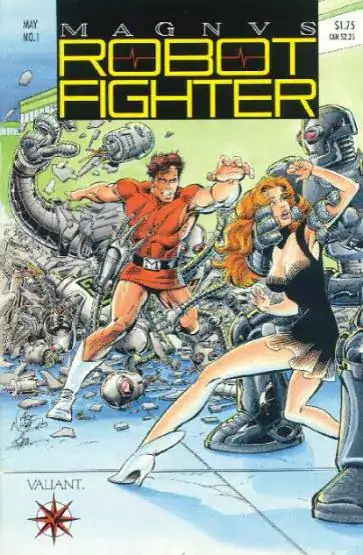
Despite the critical success, Shooter was ousted from Valiant in 1992.
He went on to found Defiant Comics in 1993, Broadway Comics in 1995, and relaunch Acclaum Comics in 2000, all of which didn’t last long.
SHOOTER’S RETURN TO THE LEGION
During the so-called “Threeboot”, in 2007 Jim Shooter returned to his original comic book child, writing Volume 5 from issue 37 to issue 49.
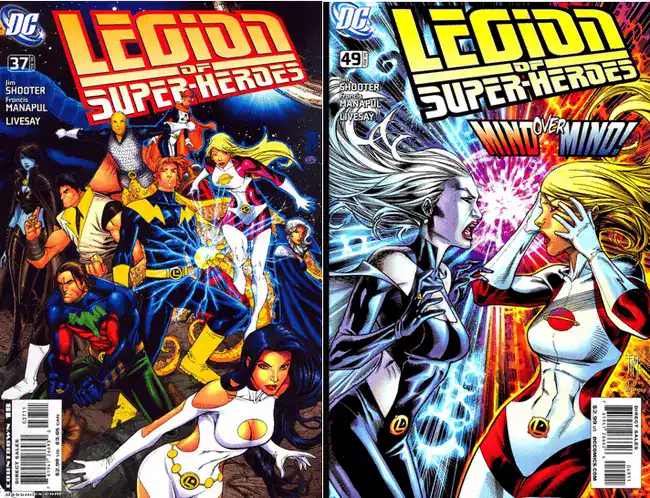
You might have expected DC Comics to publicize the return of a legendary creator.
Instead, in what I believe is one of the most damaging moves to the Legion ever… they BARELY promoted Shooter’s new run, while simultaneously giving PLENTY of publicity to the “Lightning Saga” on the pages of Justice League, where Geoff Johns re-introduced the pre-5YL Legion.
All of this WHILE THE OTHER CONTINUITY WAS STILL RUNNING.
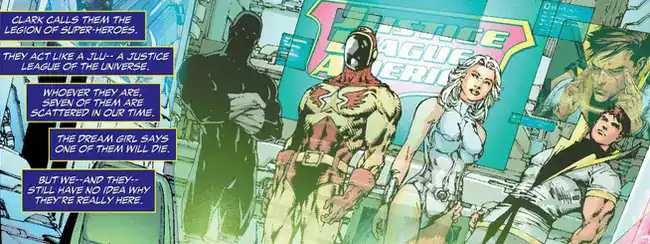
I have PLENTY of thoughts on that idiotic decision, which I believe is what eventually caused the Legion to collapse.
But Shooter’s run was the first to fall. Issue #50 was under the pseudonym “Justin Tyme”, and that was also the last issue of the book.
An unimpeachable source, an old friend in a position to know, tells me that sales of comics are down in general, and that sales of DC comics are down in particular, pretty much across the board. Sales of ‘The Legion of Super-Heroes’ aren’t great, but they’re a lot better than those of some of the titles they’re keeping. I think canceling the book is a graceful way of getting rid of me. I complain too much and too loudly.
JIM SHOOTER
OTHER CREATORS ON JIM SHOOTER’S PASSING
Jim was a complex man, and our relationship was just one of the minor complexities.
[CUT FOR BREVITY]
Jim was an excellent superhero writer, a character creator, an editor with an eagle eye, and a man who gave his all to what he did. From my perspective, he was far weaker as an enterprise leader, and unfortunately, that was what he most wanted to be. His sense of history was not, in my view, as good as his sense of fiction. But what he did well, he did gloriously…and my inner child will always be grateful for his inspiration.
PAUL LEVITZ
When old Marvel was at 387 Park Ave. S., Jim’s office was adjacent to Anne Nocenti’s. Baseboard heating ran through Jim’s office into Anne’s. Consequently, some of the conversations in Jim’s office could be heard in Anne’s. I don’t remember who told me, but it was reported that once my name came up, Jim was overheard to say, “Simonson. Another big gun who can’t be aimed.” I loved it. I’ll be using that as my epitaph. LOL. We’re saddened by your departure but glad you’re free from pain, Jim. Godspeed.
WALT SIMONSON
Later, after I broke into comics in 1987-l’ll never forget the first time I was brought into the Marvel offices. Jim gave me a 15-minute crash course in storytelling (which he apparently did for all new pros getting hired at the House of Ideas); it was as informative as it was succinct-absolutely masterful.
JIM LEE
I wish nothing but peace for a man who rarely seemed at peace. He was instrumental in my career and I thank him for that. Though he was complicated, I believe Marvel, the direct market, and possibly the industry itself, might not exist today without what Jim Shooter did as EiC.
FABIAN NICIEZA
That last Nicieza quote summarizes Shooter best… truly a man who was a force of nature, in good and bad ways.
Top: Jim Shooter in his teens and in 1987
Bottom: in 2010 and 2025
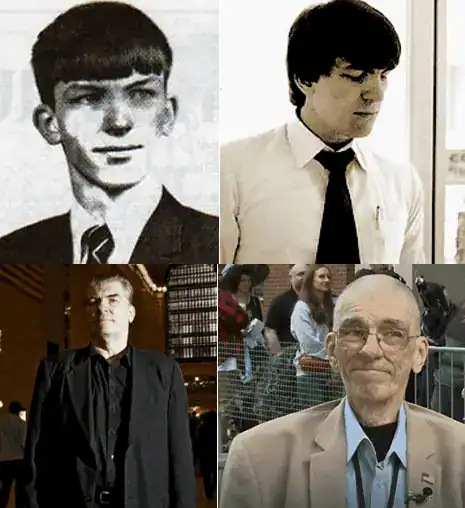
But underneath it all, a boundless love for comics.
Will Eisner and I were friends. Once, while we were having breakfast at a Chicago Con, we discussed the “comics market.” I told him that three times in my lifetime, comics almost died out in America. He said that it happened eight times in his lifetime! Each time, in both our experiences, the medium was saved by a major change in distribution coupled with a creative surge.
JIM SHOOTER
So long, Jim. The world would not have been the same without a 12 year old boy in a hospital bed dreaming he could write heroes.
Beautiful tribute. I knew I would find this appearing here soon after his passing.
Thanks for this detailed overview of Shooter’s career. He was truly a remarkable character.
One thing that struck me in the interview was that, even as a teenager, Shooter was smart enough to know he had to write to sell. He knew he couldn’t make wholesale changes in characters as fans are wont to do. This “write to sell” philosophy later played out in interesting ways.
It was Shooter, as Marvel EiC, who forced Claremont and Byrne to rewrite X-Men # 137 so that Marvel Girl died. His reasoning was that she had murdered five billion people and had to atone for that action. It was a watershed moment for Marvel, and a point where I thought comics had grown up by embracing a harsh reality. Whether Shooter was right or wrong in his reasoning, his decision certainly made an impact on Marvel and comics as a whole.
Four years later, he reversed that decision when he allowed Jean Grey to be alive and safely encased at the bottom of a.river while an alien entity had impersonated her as Phoenix and died. Jean’s return allowed the original X-Men to reunite in a new title, X-Factor. This was also the era of Byrne’s “back to basics” approach in FF. It seems that Marvel had gone only so far in terms of growing up and facing adult realities. Now it was back to the cozy nostalgia of the past where nothing really changes. Write to sell, indeed.
Shooter pushed boundaries in his writing and in his decisions as EiC. Not all of those decisions were popular. I loved his Valiant titles in the ’90s but was annoyed that I couldn’t purchase the final issue of the company-wide crossover. To ward off speculators, Valiant made it available only to “true fans” who had purchased all 18 or so of the previous issues across several titles. As it happened, I didn’t follow a couple of the titles. This kind of marketing strategy must have sounded good in the boardroom, but it almost caused me to drop the Valiant line altogether. (I stuck it out until Shooter was forced out of the company and the quality of writing dropped almost overnight.)
Shooter was one of those figures you could both love and hate. His ability to tell a good story was unparalleled even as his executive decisions upset fans and creators alike. But I will always think of him as one of the top tier comics writers for his work on Legion and Avengers.
Jim Shooter had his highs and lows that’s for sure. He wrote some great Legion of Super-Hero stories and I was a fan of his initial Avengers run and a pre-Frank Miller Daredevil stint. He even wrote a great What If story about the Avengers and Iron Man. Marvel also put out some great comics under his stewardship, although its true that many of the company’s titles grew “samey” after the success of the first Secret Wars miniseries (which I wasn’t a fan of …).
I feel the same about Secret Wars – it felt gimmicky – a means to extract as much coinage from the comics fan base as possible…
Thanks so much for sharing this. The most thorough and insightful look at Shooter I’ve seen.
Thanks for this tribute, Archeologist.
I will miss Shooter. Despite some significant wrong turns, he did much for the industry and for Marvel specifically.
Excellent overview/ essay on Jim Shooter. I had a pleasant exchange with him once at a Motor City Comic Con. He was genuinely surprised and amused that I asked him to sign my copy of PHOENIX THE UNTOLD STORY.
I did not know him personally, nor did I ever work for him, so I can’t comment on his character. He definitely made major strides in the comics industry. It seems he was beloved and hated on in equal measure. Creative people are very complicated.
RIP and Thanks, Jim.
Jim Shooter was the greatest contributor to the wondrous sense of continuity that characterized Marvel to the details. Under his office, there were laid the foundations that would eventually bring us the Image Comics method.
He wasn’t an easy boss, AT ALL, but Marvel is what she is thanks to his dedication.
Godspeed.
Good write-up!
I’d be interested in that Star Brand retrospective you mention. I always wondered how Shooter would have developed the series if he’d stayed on.
I think it’s clear that Shooter planned to have Ken mature & develop into a real hero over time. Ken was unsuited at the start, but he would have grown into the role.
After Shooter left, Byrne reveals that the alien who gave Ken his powers was not an alien at all. I think the New Universe editors decided aliens were too unrealistic, or not fitting the rest of the New U, since they also retconned Justice as a human.
But I always wondered whether Shooter intended it to be a real alien, and if not, what his plan was. Presumably something quite different to what Byrne ended up revealing.
Given Ken’s conversation with the Old Man in their las confrontations, where he highlights the inconsistencies of the alien story, I assume Shooter would also have dropped that angle.
Unfortunately there’s no way to be sure.
Somehow, all those months ago, I overlooked the link you posted to this essay in one of the Legion World forums!
Better late than never, I suppose.
I think you did a perfect job of balancing the good and the not-so-good things about Shooter as both a creator and a human being. Kudos!
Another artist who left Marvel because of Shooter was Gil Kane. Ironically, Kane & Shooter collaborated closely on What If #3, where the Avengers break up as quickly as they were formed, leaving Iron Man to cobble together an “Iron Legion” in order to battle the menaces of Namor and the Hulk. I consider that story one of the best works by both those men! They also co-created Bullseye!
Other Shooter works I like are Unity (everything Secret Wars should have been but was not,) and the majority of his Legion stories from Adventure and Action. His second run on Legion tended to be iffy (I’m being polite here,) but I loved the introduction of the Super-Rejects (Calorie Queen has great potential) the origin of Karate Kid, and especially Element Lad avenging the Trommites. Mike Grell is not my favorite Legion artist, but he really delivered on those stories (Ironically, Grell hated working with Shooter. Go figure. LOL.)
Thanks for a great job remembering Shooter.