
One of the most annoying parts of the 5YL era, at least to me, was its adherence to an extremely rigid 9-panel grid.
I already discussed my reasons for hating it, but now that I’ve gone through the entire era… just how bad was the grid used, anyway?
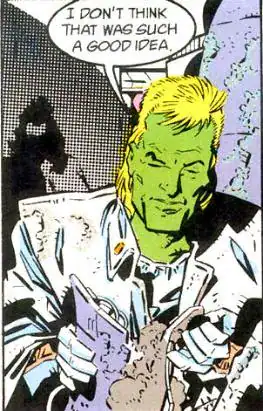
As a reminder for my terminology: I define this as a Perfect Grid…
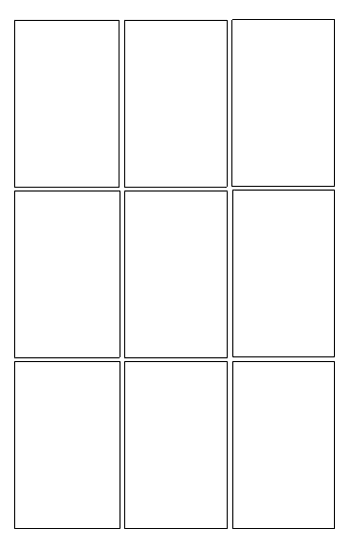
…and this as an Imperfect Grid.
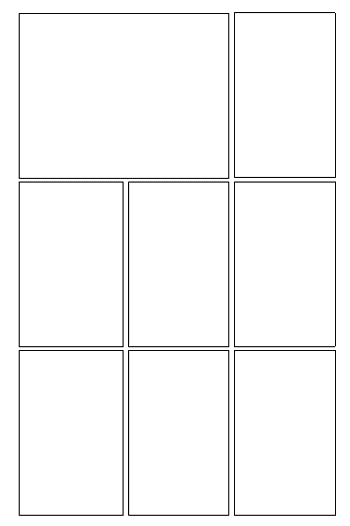
I don’t dislike the grid in principle: it can be used effectively, especially when you break it up with either Imperfect Grids or other layouts.
My gripe against the 5YL use of The Grid is that it’s RELENTLESS, constricting the creativity of the story and making it a chore to even just flip through the pages.
Let’s analyze just how relentless it was.
The go-to comparison (even at the time of the 5YL publishing) is always Watchmen, which greatly popularized the use of The Grid… but as I’ve argued before, it’s not a good comparison because Watchmen breaks it up with an Imperfect Grid for a lot of pages.
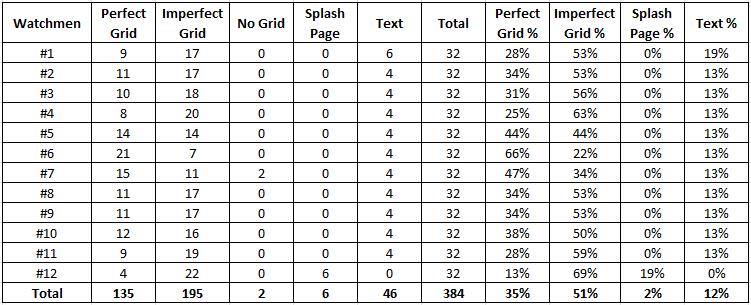
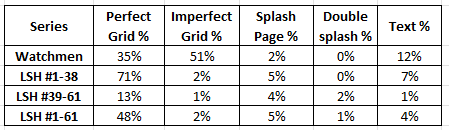
To put that in perspective, here is the graphic of how this breaks down.
(you can click on all graphs to get a better view)

Watchmen having 35% of pages being a Perfect Grid certainly SOUNDS a lot, but compare it to the main 5YL series (I’m not doing the analysis with the other books since they barely use the grid).
But the Giffen era DOUBLES that number, while barely using the Imperfect Grid and typically breaking them with splash pages.
Even when the post-Giffen era severely reduces the grid pages, if the series is taken as a while it STILL beats Watchmen.
To put that in a graph, notice how there’s BARELY any space between the Perfect Grid and the total number of pages in the Giffen era.

The Imperfect Grid is almost non-existent.

Contrast with the post-Giffen era, where The Grid is only present in a handful of issues and the Imperfect Grid has basically disappeared.
Issue 50 is not shown in its entirety: since it has 50 total pages and just 2 grid pages, it would make the rest of the graph barely visible!

If you take a look at the whole series, you can see just how much the use of The Grid changes whenever Giffen is not drawing the entire issue or when he leaves.

Text pages are something else associated with the 5YL era.
Watchmen had 4 text pages in every issue except the first (which had 6) and the last (which had none). 
They might as well not exist after Giffen leaves, and there’s never more than one.

Watchmen also limited its splash pages (only 6 and all in the last issue), but they are pretty frequent throughout the entire 5YL era. The post-Giffen era also introduces double splash pages, which were not present in either Watchmen or the Giffen issues.
Issue 38, which was only made of splash pages, is not shown to scale…

…for a good reason.

The number of pages also fluctuates A LOT.
It typically ranges from 24 to 26 pages, with a couple of issue going as low as 23 pages and of course Issue 50 being out of scale with 50 pages.

To close off this totally necessary breakdown, some records:
Lowest number of pages: 23 pages, LSH #2 and LSH #5
Highest number of pages: 50 pages for LSH #50 and 28 pages for LSH#54
Smallest non-zero number of Perfect Grid pages: 1 page, LSH #40 and LSH #44 (4.2% of the total)
Smallest non-zero % of Perfect Grid pages: LSH #50 with 4.0% (2 pages out of 50)
Highest number of Perfect Grid pages: 24 pages, LSH #32 and LSH #36
Highest % of Grid pages: LSH #36 with 100% of pages (beating LSH #32 which at least had 1 text page too)
Most splash pages: 25 pages (100%) for LSH #38, beating the four issues with 3 splash pages each (#12, #26, #49 and #61)
Most double splash pages: #45 and #61 are the only ones with 2 double splash pages
Most splash + double splash pages: #38 still has the highest percentage, since it’s ALL splash pages, but #61 is notable because 12% of the issue is either splash or double splash pages
And finally, the other statistic exclusive to this era: the Depression score.
This is hard to score because I gave a ∞/10 score to FIVE issues, which obviously wouldn’t show up in a graph… so if I reduce those to a mere 10/10, how would that look?

Surprisingly, the score I assigned the most was a 6/10 (given 10 times) followed by a 0/10 (given 7 times) and a 10/10 (given 6 times).
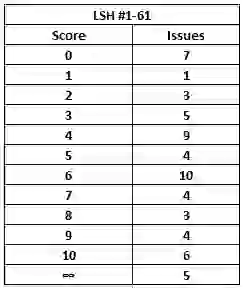
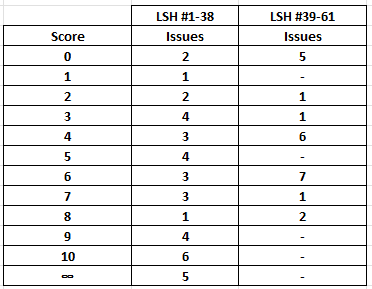
But that’s only because of the post-Giffen era.
If I split this up, the most assigned score for the first half of the era is 10/10 and the most assigned for the second half is 6/10.
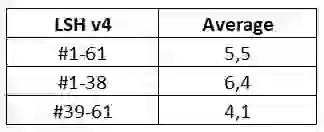
Spread across 61 issues, this results in an average depression score of 5.5/10
Even counting just the Giffen issues, that only rises up to 6.4/10
But that hardly sounds right, considering the score was above infinity FIVE TIMES.
What if I balance that out a bit, counting the ∞/10 score as a more trackable 100/10 score?
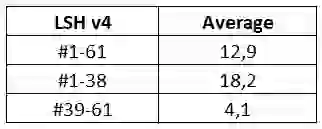
Yeah, this entire era having a Depression Score of 12.9/10 and the Giffen Era rising to a 18.2/10 tracks my opinion much better.

A comprehensive mathematical analysis of the miserable grid era was not something I would have ever expected to see. Great job.
12,9 out of 10 during giffen, to drop to 4.1 after Giffen,
NUFF SAID!