
Amazing Spider-Man Annual #1 (1964)
by Stan Lee & Steve Ditko
Electro joins the Sinister Six in his third appearance.
This is in line with most of the team: Doctor Octopus, Vulture and Sandman also had 2 prior appearances, while both Mysterio and Kraven only showed up once before this.
Notably, out of the six Electro is the ONLY villain who had faced a different hero: everyone else only fought Spider-Man.
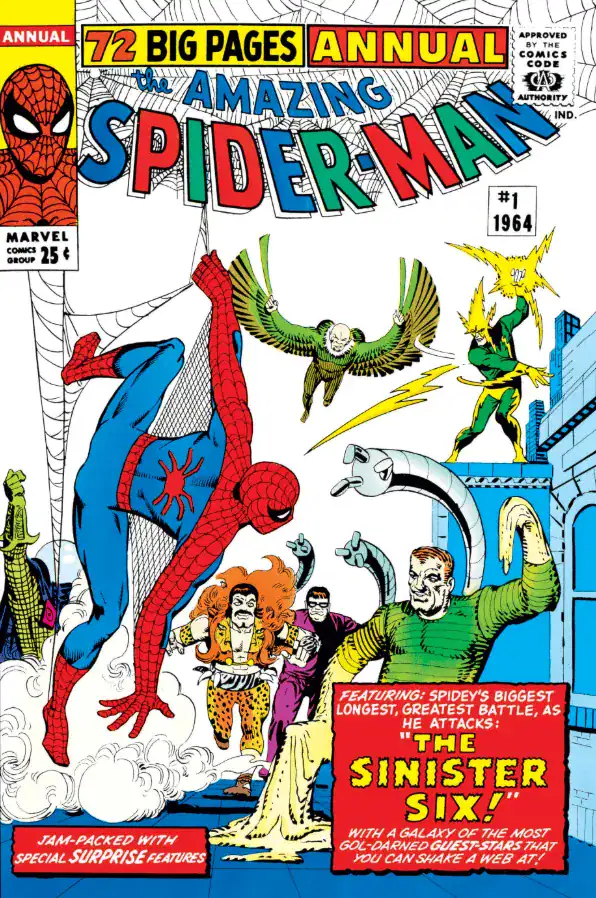
You would expect this would make Electro more respected by the others, but the fact that he fought Daredevil is not acknowledged.
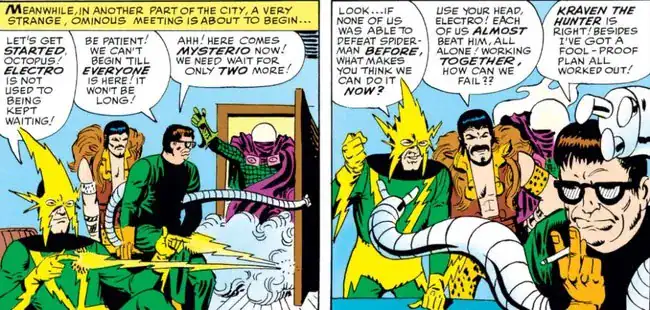
Since this retrospective is dedicated to the times Electro fought OTHER heroes, I’m not going to review this one. Just keep in mind that Electro is basically interchangeable with any member of the Sinister Six who isn’t Doc Ock.
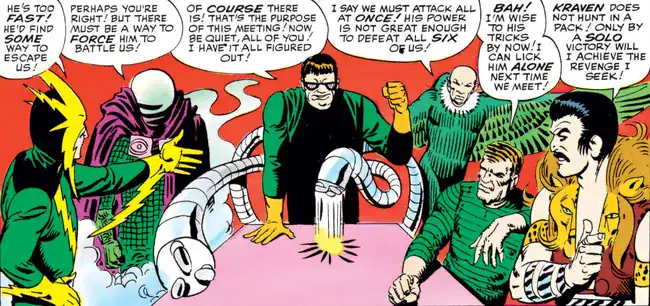
Despite Octopus being very straightforward with the concept behind the Sinister Six… join forces to fight their enemy… they DON’T attack Spider-Man together.

Once again Electro needs to power himself with an external source…
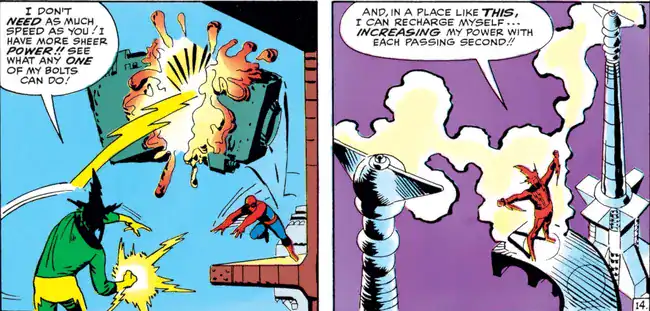
…and once again he’s defeated, although not with water this time.
The issue is also notable for featuring splash pages of Spider-Man fighting each villain; this was rare in general in 1964 and unprecedented for Spider-Man, since I don’t think Ditko ever liked doing splash pages.
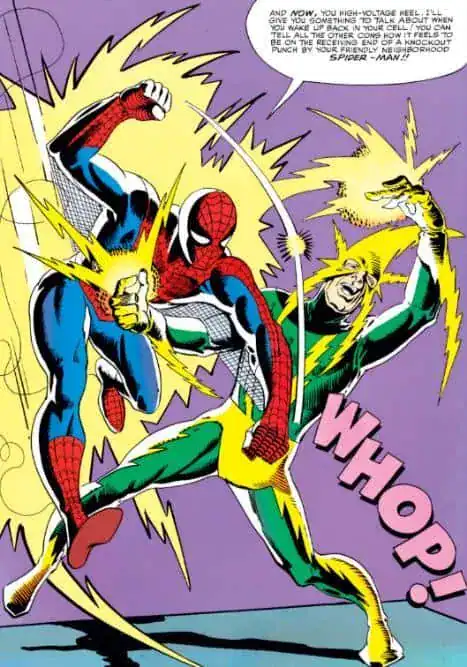
Overall, Electro doesn’t get to DO much here.
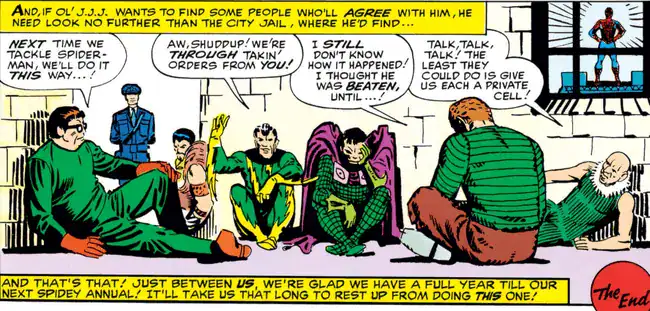
Historical significance: 10/10
It’s the Sinister Six!!!
Silver Age-ness: N/A
Does it stand the test of time? N/A
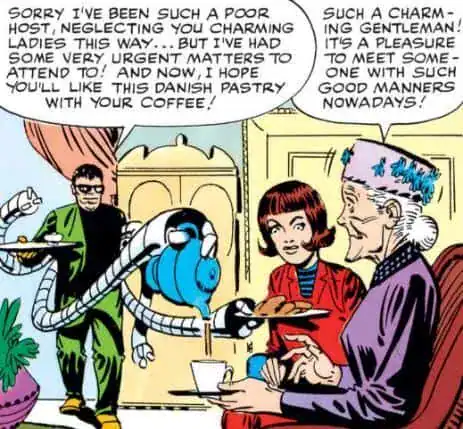
Not a real review so no scores, but it’s a classic that every true Spider-Man fan must read at some time. Although it might the origin of some Aunt May hate, because she’s just terrible in this.

I’m convinced that in this issue Aunt May is at least 95 years old…
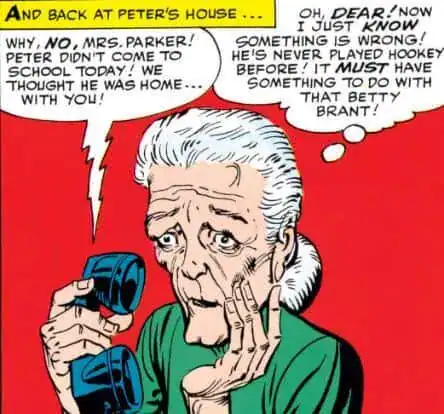
…and she 100% has dementia.
Fantastic Four Annual #3 (1965)
by Stan Lee & Jack Kirby
Like basically everyone who existed at the time, Electro crashes the wedding of Reed and Susan.

No point in discussing this cameo, other that I’m pretty sure this is the only time Jack Kirby draws Electro.
Daredevil Annual #1 (1967)
by Stan Lee & Gene Colan
Spider-Man’s first Annual featured a team composed of his worst enemies.
Daredevil’s first Annual ALSO did the same thing… but Daredevil has so few decent villains at this point that has to count Electro.
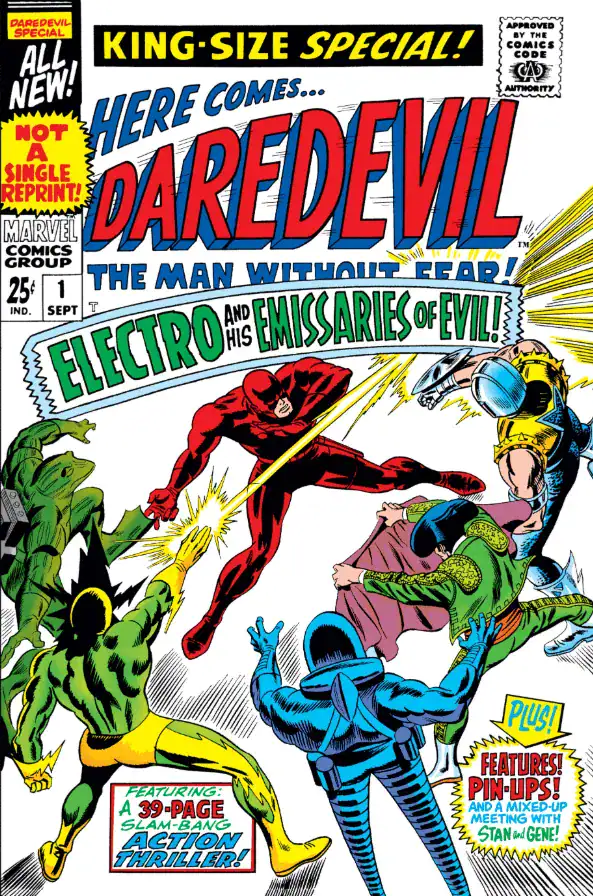
In fact, the first Daredevil villain that is spotted joining the team is his worst one by a wide margin: The Matador.
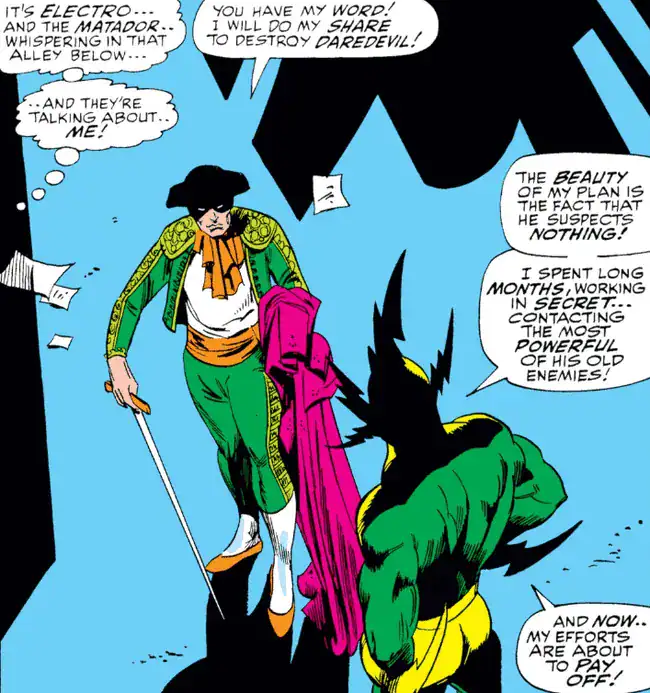
Considering that, if exclude the Fantastic Four cameo, the last time we saw Electro was with the Sinister Six… I have no doubt that he decides to found the Emissaries of Evil as an ego boost.
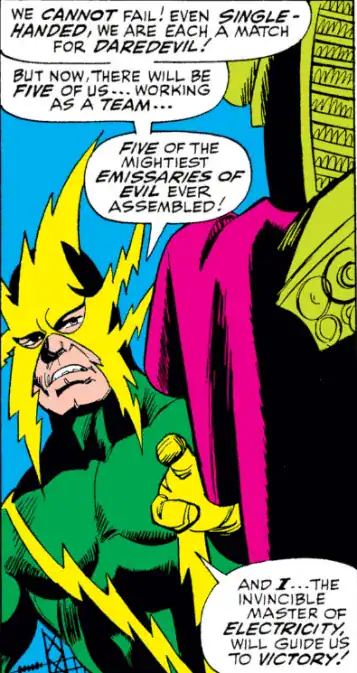
Yeah the parallels to the Sinister Six annual are EXTREMELY blatant, down to having splash pages of Daredevil fighting his villains.
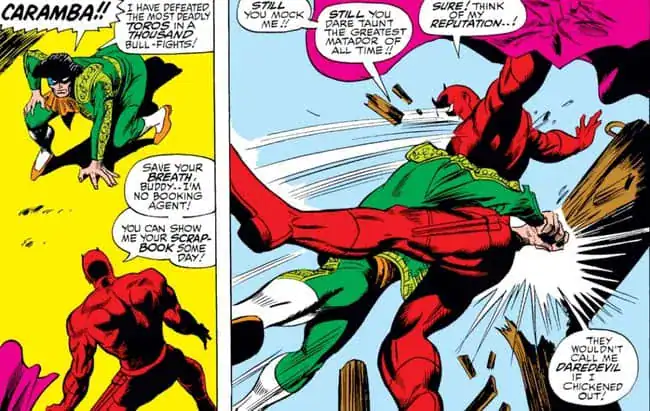
Including defeating The Matador with his butt apparently, because why would The Matador deserve more dignity than this?
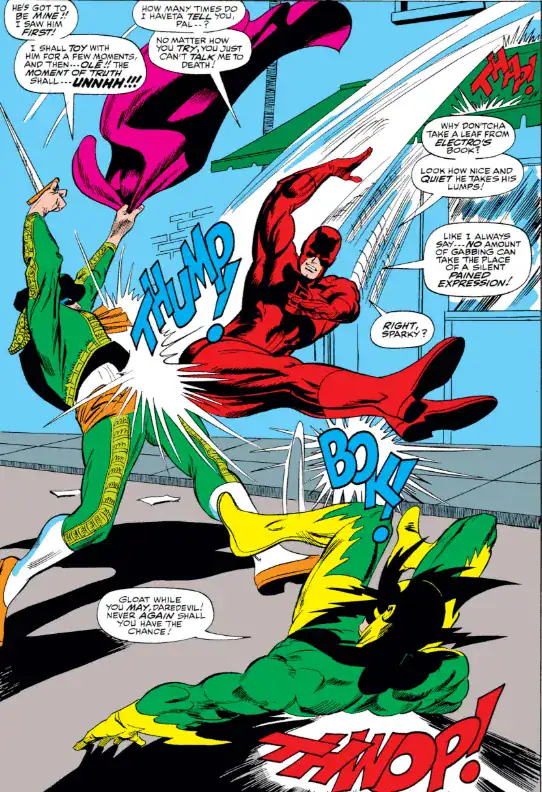
Just like I did with he first time they met, I have to stress what a TERRIBLE choice for a Daredevil villain Electro is.
He can’t even hit him with LIGHTNING when he’s AT POINT BLANK RANGE!!!
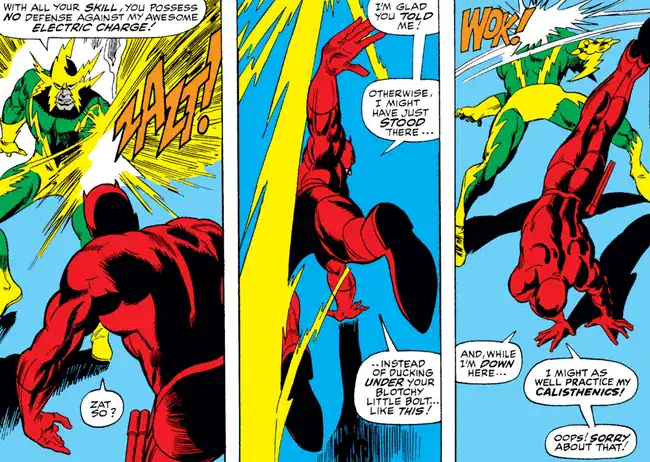
In fact, the ONLY way he manages to actually hit Daredevil is when he’s distracted by The Matador’s cape.
I should stress that the cape has no special properties whatsoever.
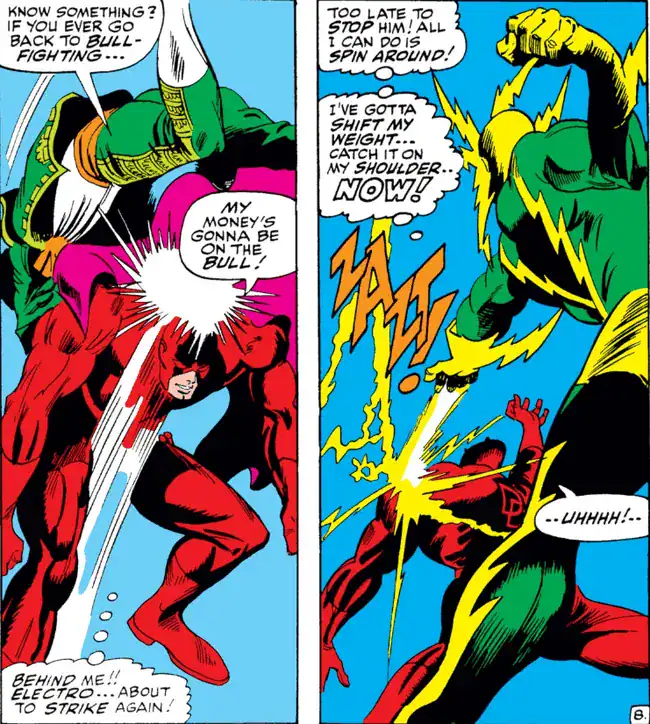
And it’s here that this story loses any possible chance to turn Electro into a good villain for the series.
How am I supposed take him seriously when he can’t even kill Daredevil after knocking him down?
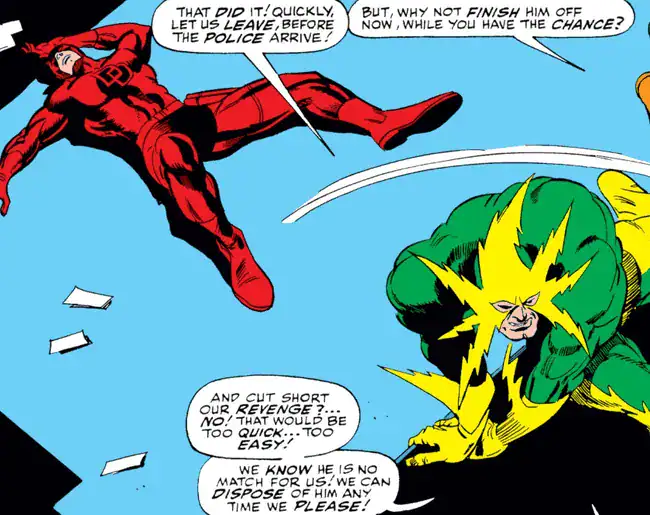
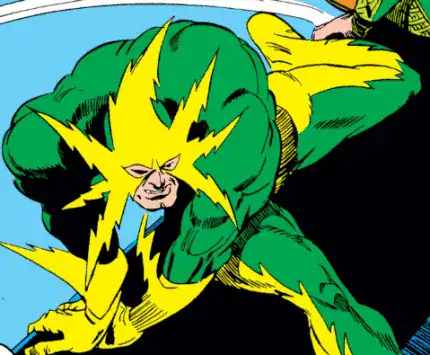
Also, a rare critique of Gene Colan who is otherwise the only saving grace of this trainwreck… has Electro been lifting, or is that a hunchback?
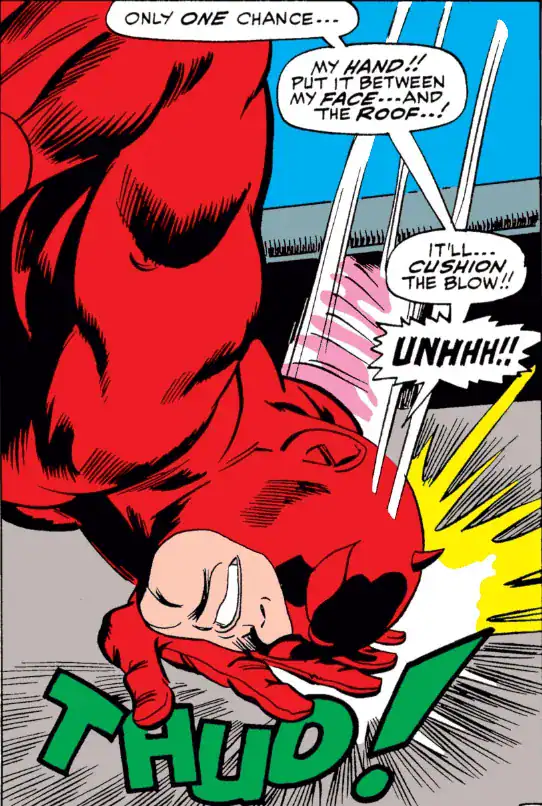
Something else that makes it hard to take this issue seriously: not only is Daredevil STILL ALIVE after that shock, but he ALSO has trouble with his super-senses…
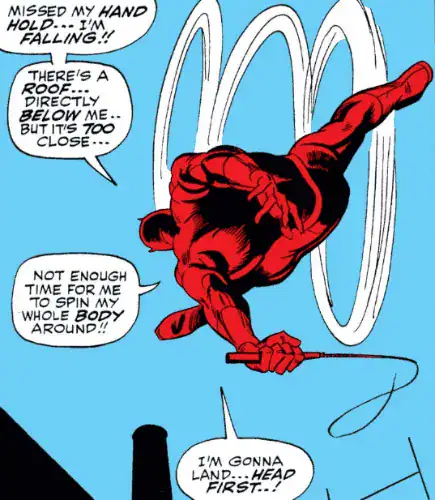
…which he fixes by slamming his head against the roof.
Even with his hand cushioning the blow… COME ON!!!
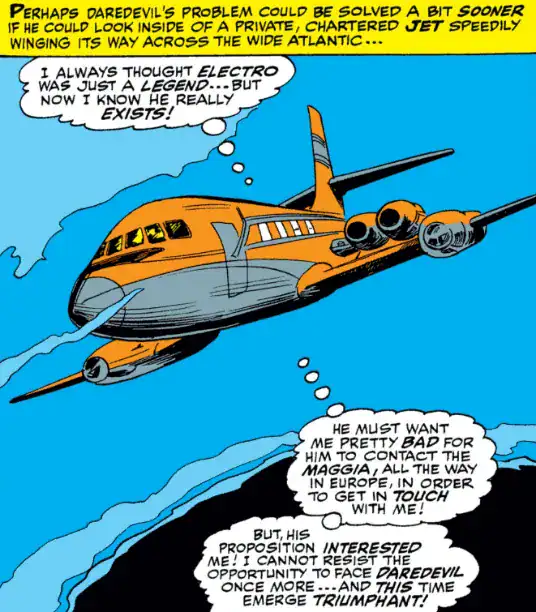
The next recruit is The Gladiator, who Electro has recruited through the Maggia… the Marvel equivalent of the mafia (although, weirdly enough, the mafia ALSO exists).
Also: The Gladiator thought that Electro was only a legend… WHY???
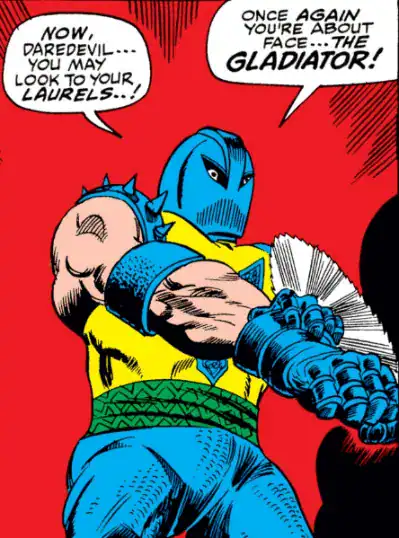
The Gladiator is definitely a step up from The Matador, although he’s several years before he becomes an interesting character.
His deep psychological issues have not been introduced yet: he’s just an enforcer with sawblades on his wrists.
But at least he’s not The Matador.
The next recruit is Stilt-Man, who I strenuously defend because he’s NOT a bad villain.
He’s just ridiculous, which does NOT mean that he can’t be dangerous! In fact, out of all the legit Daredevil villains that Electro recruits, I would say that Stilt-Man is far and above the best one.
Which admittedly is more of a case against the rest than one in favor of Stilt-Man.
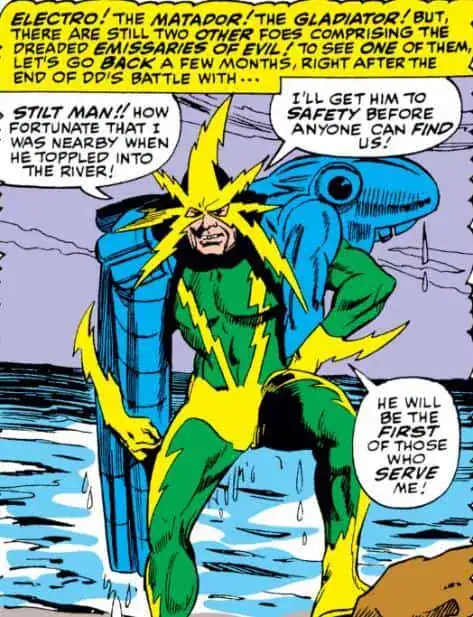
Is Electro Doctor Frankenstein now??? He’s not a super-scientist, he’s just an electrician!!!
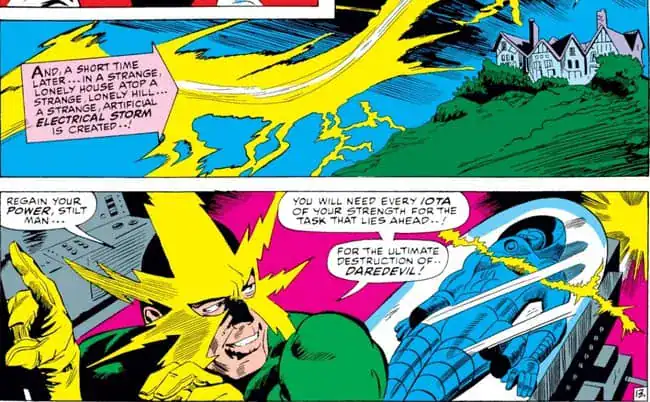
While at this point the Daredevil series has VASTLY improved over the last time Electro met him… it’s still painfully repeating the same exact subplots over and over again.
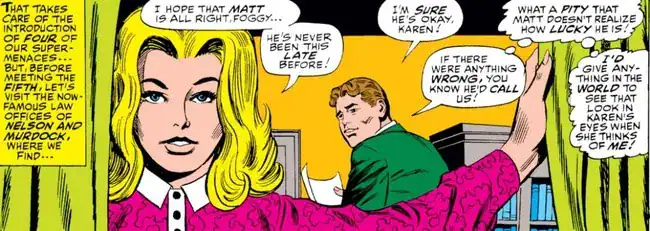
It’s always weird to see how skinny Foggy used to be.
Daredevil is right. If you don’t make fun of The Matador, I will lose my respect for you.
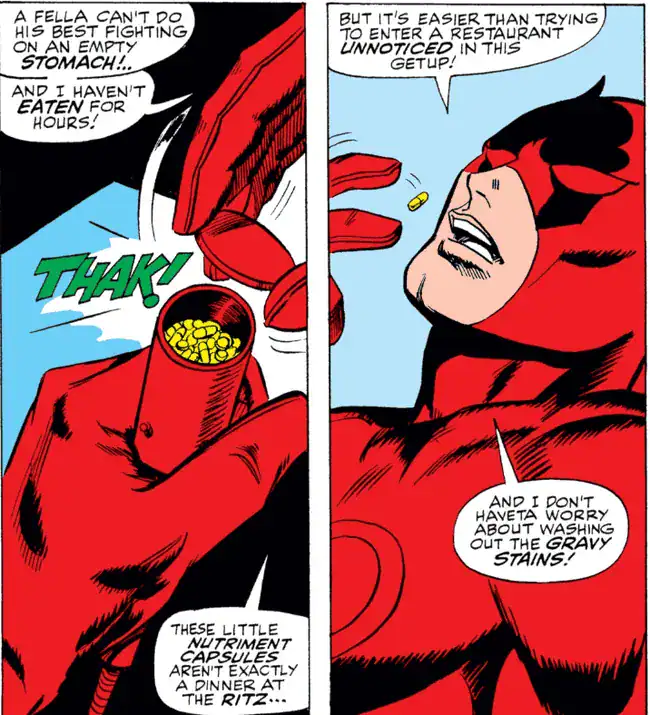
I can’t blame him for popping pills for this fight. Would YOU want to meet The Matador without being high?
I would recommend picking up this issue just to look at some gorgeous Gene Colan artwork.
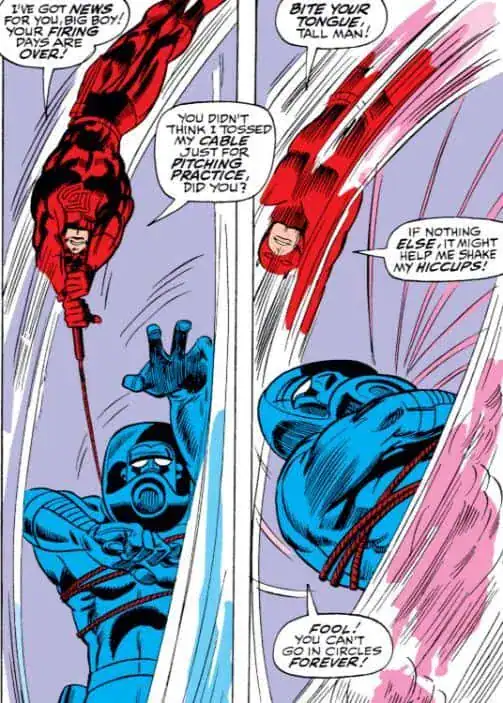
That’s certainly a better selling point than the last member of the team: Leap-Frog.

Only Gene Colan could make this fight exciting. It’s almost making me forget we are talking about Leap-Frog.
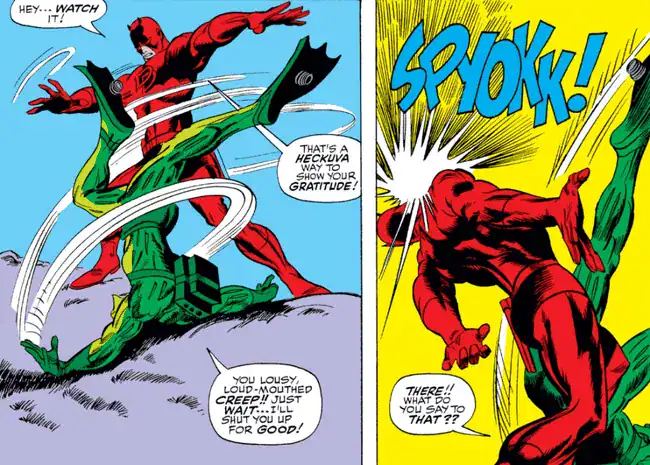
Unlike the Sinister Six, the Emissaries of Evil are smart enough to eventually attack Daredevil together.
Unfortunately… they are so incompetent that they STILL miss with a lightning blast AT POINT BLANK RANGE.
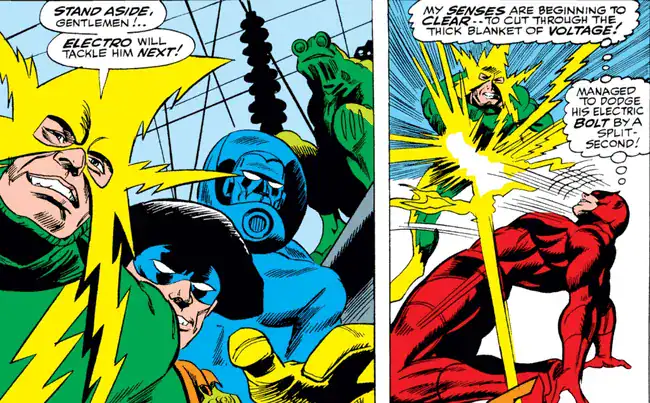
HOW IS DAREDEVIL ALIVE???
He’s tied up while facing a guy who can electrocute him and one who has SAW BLADES ON HIS HANDS, how are they missing???

Last time, Electro lost because Daredevil dropped a curtain over him.
Still a less embarrassing defeat than this.
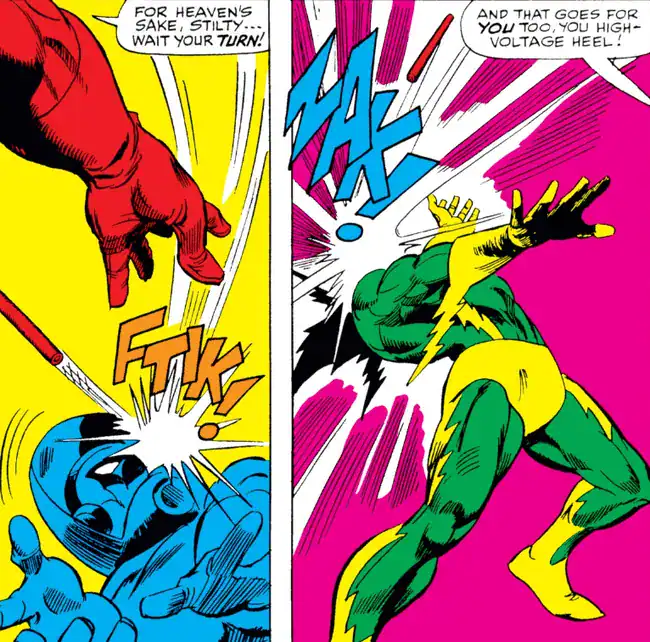
Times Electro failed to electrocute Daredevil at close range: 3
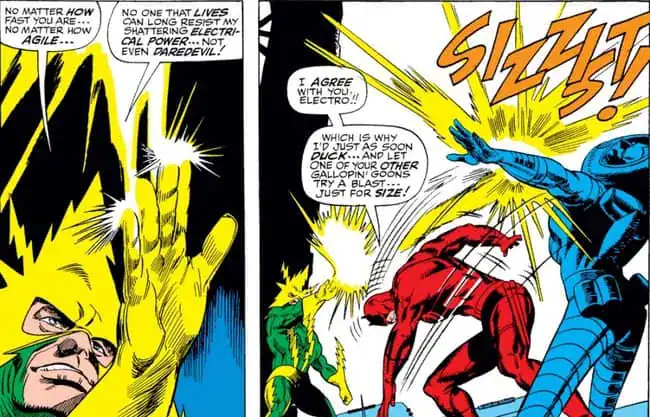
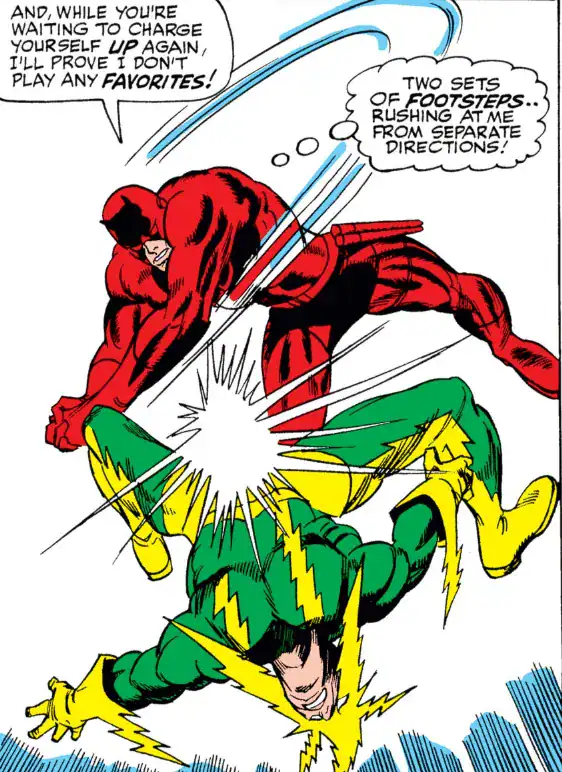
This is the first smart thing you ever said, Electro. Daredevil ABSOLUTELY SHOULD NOT be able to defeat all of you at once!
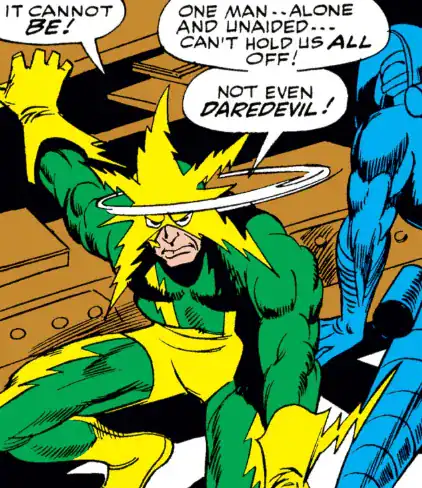
Times Electro failed to electrocute Daredevil at close range: 4

Pretty sure this is not how Electro’s powers work anywhere else.
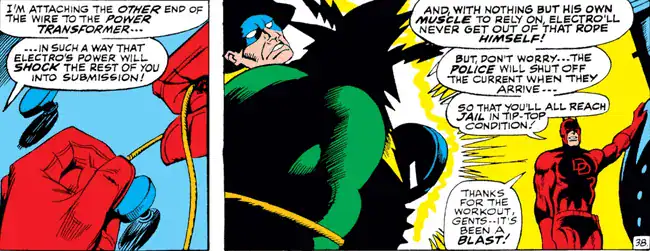
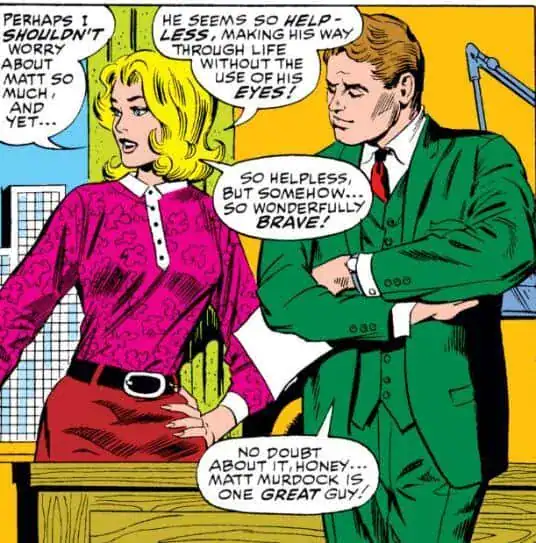
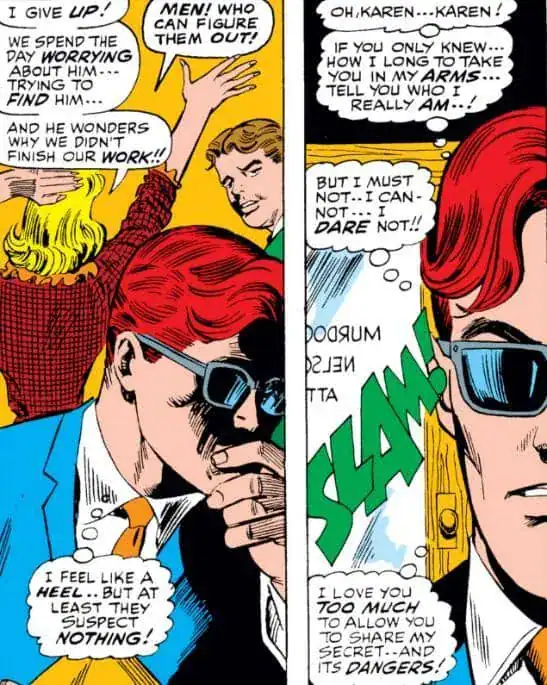
The only reason why Karen didn’t quit her job is that Matt Murdock is hot, right?
I can’t imagine he pays her enough to put up with his shenanigans.
Historical significance: 0/10
Sadly, the Emissaries of Evil do come back. Still not enough to qualify for a 1/10.
It’s also, bizarrely, the last time Electro appears in the 60s.
Silver Age-ness: 6/10
HOW IS DAREDEVIL ALIVE???
Does it stand the test of time?
If you only look at the artwork: 8/10
If you actually read the story: 0/10
Gene Colan is just on fire here. Which is a disappointment because it means he wastes 39 pages of high-octane swashbuckling adventure to a fight that involves The Matador.
There is no Sinister Six story that acknowledges Electro has been part of a similar team.
I have a hunch about how that conversation might have gone.
DOCTOR OCTOPUS: Now that the Sinister Six are back, my plan to defeat Spider-Man is…
ELECTRO: hold on, Octopus, I should be the leader this time. I have experience of being the leader of a supervillain team!
SANDMAN: Oh really? Which one?
ELECTRO: The Emissaries of Evil!
MYSTERIO: Doesn’t Magneto lead that one?
ELECTRO: That’s the Brotherhood. We fought Daredevil!
KRAVEN: A worthy opponent! Never heard of such a team, who did you lead into battle?
ELECTRO: Stilt-Man, Gladiator and Leap-Frog!
EVERYONE ELSE: …
ELECTRO: And the Matador.
EVERYONE ELSE: …
ELECTRO: So Octopus, you were saying about your plan?
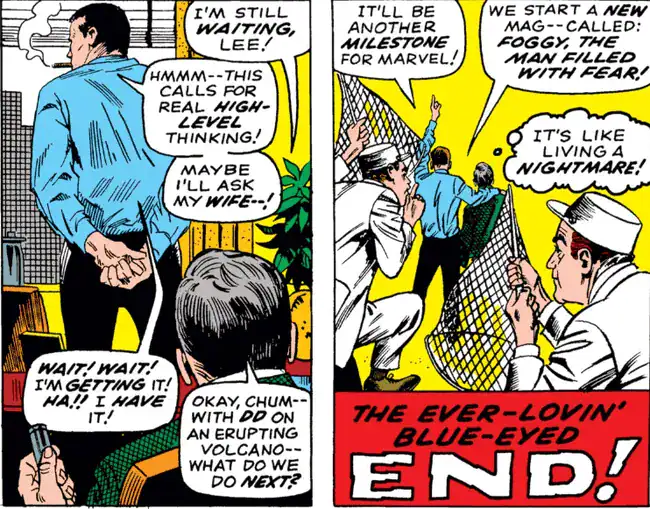
Bonus: we have a short story that explains how Stan Lee and Gene Colan create the story.
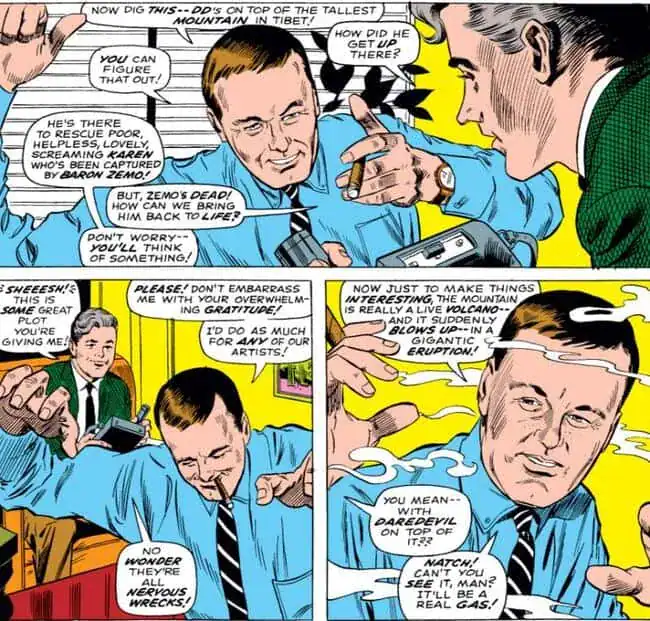
All the Stan Lee haters that claim he was some kind of monster that took credit for writing everything while never doing any actual work forget that he put out stories like this one, which goes out of its way to point out how much heavy lifting the artist did.
I guess Spidrr-Man and Daredevil must have discussed Electro and decided that they should both use the nickname “High-Voltage Heel” for him.
“Notably, out of the six Electro is the ONLY villain who had faced a different hero: everyone else only fought Spider-Man.”
Small correction, Sandman fought the Human Torch in Strange Tales #115… published with a cover date of December 1963. In fact, Sandman is in the same situation as Electro because he also only had one appearance in Amazing Spider-Man, fought another hero, and returned in the Annual.
As I recall it, back in the mid-1970s it was considerably difficult to obtain pictures without taking them oneself or physically transporting the media. Newspapers had to resort to a service called “wirephoto” in order to have printable images of recent events from other cities, and the quality of the end result was often rather questionable. The best current comparison might be to a JPG compressed with poorly chosen parameters, resulting in very visible artifacts. That service relied on then-current radio and telephone bandwiths, which were rather limited and often expensive by current expectations. Even voice calls between different cities were rather expensive, at least here in Brazil.
Things changed quite a lot with the widespread adoption of large bandwith internet and the many technologies that rely on it. It is easy to forget how significant even the adoption of the intermediate technology of fac-simile telephone transmission was; it took people by storm in the 1980s and 1990s and gave a measure of status to early adopters.
Of course, then came the World Wide Web and later increasingly faster modems and internet dedicated cables, making wirephoto very obsolete and fax almost entirely obsolete rather soon.
I say this to remind us both that physical distances used to have much more impact in the availability of information than they do now. It wasn’t just a matter of speed; you also had to have a clearer idea of what you wanted to learn about and how and where to look for that. In other words, that was before digital spam and targeted digital advertisement were much in the way of real things that actually existed.
It is possible that a side-effect of those technological limitations is that people felt generally less certain about the reliability of news from elsewhere. Hence Gladiator being surprised that Electro was a real villain as opposed to an urban legend. Particularly since, as we saw in the previous entry of this series, Amazing Spider-Man #9 had Jonah Jameson claiming that Spider-Man was Electro. I figure the Daily Bugle wasn’t at the apex of its credibility at that point, and it would not surprise me too much to learn that some people still doubted Spider-Man’s own existence at the time – or maybe thought he was an actor paid to bring publicity for the Bugle.
As for Stan Lee and his co-creators… I think that there is a fair argument to make about giving Kirby, Ditko, Colan and others proper credit and compensation when Stan Lee failed to do so at the proper time.
But it does not follow that Lee wanted to be perceived as the only creator; this and other stories show plenty well that he saw himself as a part of several creative teams and was not afraid of making fun of himself and praising the patience that his co-workers had towards him. He often praised the artists in his books and, far as I can tell, there is no clear evidence that he treated them any worse than other writers and editors of the times did.
There is also the perhaps unconfortable but plain reality that most of his co-creators had the opportunity to work independently or with other partners and rarely achieved anywhere near the same level of commercial success that they had with Stan. There are fair criticisms to extend to Stan Lee, but he was patently a successful marketeer and publicist of Marvel’s intellectual property if nothing else. Kirby and others achieved good reputations and critical success without him, but it wasn’t until the 1990s that a clear example of artist writing his own stories turned into mainstream success (Todd McFarlane). Even Kirby and Ditko simply did not create that much impact with their later partnerships with Marvel and DC on their own or with other writers – Kirby’s “The Losers”, Black Panther and Captain America in the 1970s, Eternals, New Gods, Kamandi, Etrigan the Demon, OMAC, Ditko’s Hawk, Dove, Odd Man, Creeper, Speedball, and Machine Man for both. They were hardly blacklisted, although I doubt they were marveled at the level publicity and financial compensation that they had at the time.
You can argue that it took until the 1990s for the means for independents to publish to any significant degree outside of Marvel and DC to exist, but I think that argument cuts both ways. Stan Lee and other editors had to deal with very significant distribution challenges, particularly at Marvel in the early 1960s. Distribution is a major concern even today, particularly for paper “floppies”.
It is much easier indeed for creators with an independent streak to publish an actual comic book at the present time (particularly if it is in digital form), but that also means that the consumer real state is disputed by far more competitors big and small than ever existed up until the 1980s. It is much harder to make a name as a solo creator. The competition is fierce and intense.
Bizarre factoid: that back-up is first time Zemo is reffered as Baron. Look at his original stories and he’s only refered as Dr Zemo or most often just Zemo.